
Robotic
Agibot Hits 10,000 Humanoid Robots: The Production Milestone That Changes Everything
Chinese robotics firm Agibot has shipped its 10,000th humanoid robot, doubling production in just three months and signaling a new era of mass deployment.

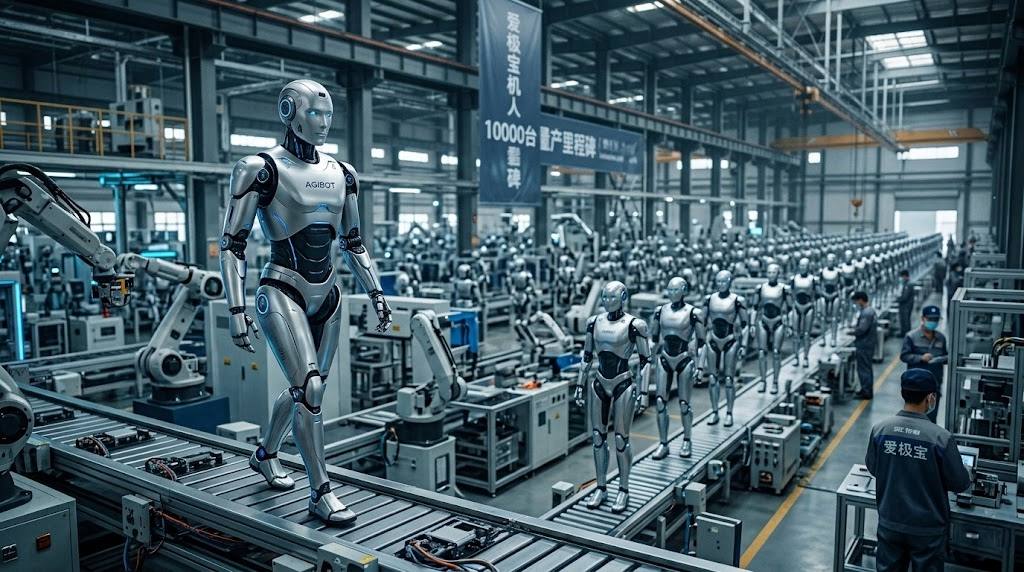
On March 30, 2026, Shanghai-based Agibot rolled its 10,000th humanoid robot off the production line — becoming one of the first companies in the industry to reach this threshold at genuine commercial scale. What makes this number remarkable isn’t just its size; it’s the speed. Agibot went from 5,000 to 10,000 units in only three months, a pace more than four times faster than its previous production phase. That kind of acceleration, in an industry that has spent years promising mass deployment, is worth paying close attention to.
From Prototype Dreams to Production Reality
Agibot was founded in February 2023 by former Huawei engineers Deng Taihua (CEO) and Peng Zhihui (CTO) — the latter having built a cult following in China for personal robotics projects, including a self-driving bicycle and an Iron Man-style robotic arm. The company moved fast: it secured six funding rounds from major backers including HongShan (Sequoia China), Baidu, and SAIC Motor, reaching a valuation north of $960 million USD before its third birthday.
The production numbers are telling. It took Agibot nearly two years to hit its first 1,000 units, about a year to scale to 5,000, and just three months to double that to 10,000. According to analyst firm Omdia, Agibot shipped 5,168 humanoid robots in 2025 alone — more than any other company globally, in a market that collectively shipped roughly 13,000 units industry-wide that year. That means Agibot commanded roughly 40% of global humanoid robot shipments in 2025.
Where the Robots Are Going
These aren’t warehouse curiosities sitting in labs. Agibot’s robots are deployed across logistics, retail showrooms, hospitality services, education, and increasingly, industrial manufacturing lines. Their flagship A2 bipedal humanoid stands 1.75 meters tall and is capable of tasks as precise as threading a needle. The industrial-grade G2 wheeled model achieves sub-millimeter assembly precision with force control suited for automotive-grade tasks. The company’s embodied AI operating system, Lingqu OS, runs across their product family — providing a common software foundation that speeds up real-world deployment.
This isn’t a single product story. Agibot’s portfolio now spans six product lines ranging from the ~$20,000 X2 education robot to the full-size A2 priced between $100,000–$190,000. That product breadth — from classroom to factory floor — positions Agibot as something genuinely different from the narrowly focused Western competitors still figuring out their first commercial deployment.
The China Advantage — and Its Implications
Agibot’s milestone doesn’t exist in a vacuum. It’s part of a broader Chinese push to dominate humanoid robotics at scale. In late February 2026, China’s Ministry of Industry and Information Technology published its first national standard system for humanoid robots and embodied intelligence — a formal framework covering brain-like computing, limb components, full-machine systems, and safety ethics. More than 120 researchers and policymakers convened in Beijing to establish these standards, signaling that China is treating humanoid robotics as a strategic national industry, not just a startup story.
The contrast with Western competitors is sharp. Tesla’s Optimus program, despite years of headlines, is still in R&D phase with no robots confirmed doing productive work in factories as of Q1 2026. Figure AI carries a $39 billion Series C valuation that many analysts view as running ahead of commercial reality. Boston Dynamics is shipping its electric Atlas — but all 2026 units are already committed to Hyundai’s facilities and Google DeepMind. Meanwhile, Agibot has already shipped 10,000 robots across real-world paying customers.
Physical AI Investment Is Accelerating Globally
Agibot’s milestone lands at a moment of unprecedented investor conviction in physical AI. Q1 2026 saw $300 billion flow into global venture deals, with AI commanding 80% of that total. Physical Intelligence — the two-year-old San Francisco startup building foundation models for robots — is reportedly in talks to raise $1 billion at an $11 billion valuation, effectively doubling its valuation in just four months. The robotics funding boom is real, and it’s not confined to any one geography.
But there’s an important distinction between capital and output. Agibot has translated investment into actual units, actual deployments, and actual production velocity. That’s the gap that matters — and it’s the gap that the rest of the industry is racing to close.
InteliDroid Perspective
The vision at InteliDroid has always been a future where capable, versatile humanoid robots are widely owned and genuinely useful — not just enterprise curiosities locked behind million-dollar contracts. Agibot’s 10,000-unit milestone moves that vision measurably closer to reality. When production curves bend this sharply upward, prices tend to follow — downward. The X2 at $20,000 and the A2 at $100,000–$190,000 are still out of reach for most consumers, but the economics of scale are doing their work.
China reaching this production threshold first matters not just competitively, but for the whole industry. It proves that humanoid robots can be manufactured at commercial scale. What happens in Agibot’s Shanghai facility today shapes what robots cost — and who can afford them — tomorrow.
What to Watch Next
Keep an eye on whether Western humanoid robot makers respond to Agibot’s production momentum with accelerated timelines of their own — and watch for Agibot’s next pricing moves as it eyes global market expansion beyond China.


Humanoid Robots
Gatsby Sends a Humanoid Robot Into an American Home — History Made at $150
San Francisco startup Gatsby made U.S. history on May 14, 2026, dispatching a humanoid robot to complete the first-ever paid residential cleaning for an American consumer — at a flat rate of $150 per clean.
A San Francisco startup just quietly rewrote history. On May 14, 2026, a humanoid robot entered a customer’s apartment, cleaned it from top to bottom, and walked back out — the first time a humanoid machine has ever performed a paid residential cleaning for an end consumer in the United States.
The company behind the milestone is Gatsby, founded in January 2026. Most people hadn’t heard of it. That changes now.
The Moment Happened Quietly — But It Changes Everything
Gatsby selected its first customer entirely at random from a waitlist of eager San Francisco residents. The customer booked through the Gatsby iOS app like any ride-share or food delivery order. The humanoid robot arrived, navigated the apartment autonomously, cleaned it, and left. No human supervisor on-site. No controlled media environment. Just a machine doing housework in a stranger’s home.
This wasn’t a demo for investors. It wasn’t a proof-of-concept with a pre-vetted partner. It was a real commercial transaction — the first of its kind in American history.
Gatsby founder and CEO Aron Frishberg, who left the University of Chicago to build the company under parent firm West Egg Labs, was direct about what’s at stake: “Housework is the largest unpaid job in human history, and it falls hardest on the people with the least time to give. We’ve mapped every neuron and synapse in a fruit fly’s brain, yet we still clean our homes the same way our ancestors did hundreds of years ago.”
$150 to Have a Robot Clean Your Apartment
Gatsby charges a flat rate of $150 per cleaning, regardless of apartment size. Professional human cleaning services in San Francisco typically run between $150 and $300 per visit. On price alone, the robot is immediately competitive.
The service is currently live only in the San Francisco Bay Area, but the waitlist has expanded well beyond the city. Gatsby has signaled plans to scale nationally as operations mature.
For context: consumers have been willing to pay $30 for a 20-minute Uber ride and $15 for grocery delivery. A $150 apartment cleaning — with no scheduling headaches, no background check anxiety, and guaranteed consistency — sits in a price range that millions of households already spend on cleaning services. The robot just removes the human friction entirely.
Gatsby Isn’t Building a Robot — It’s Building the Platform
Here’s what makes Gatsby’s approach strategically distinctive: the company is hardware-agnostic. It does not manufacture its own humanoid robot. Instead, it is building the consumer distribution layer — the software stack, home navigation systems, booking interface, and operational infrastructure required to deploy any humanoid robot into a real residential environment.
Think Uber, not General Motors. Think Airbnb, not Marriott.
While Tesla Optimus, Figure AI, 1X Technologies, and others are spending billions racing to build the ideal mechanical body, Gatsby is betting that the distribution layer — the interface between robots and real consumers — is where the lasting value accumulates. If a cheaper, more capable robot ships next quarter, Gatsby can integrate it and immediately upgrade its service fleet without rebuilding its business model from scratch.
The company is backed by NVIDIA Inception and Entrepreneurs First, two organizations with strong track records of identifying foundational infrastructure plays in emerging tech categories.
Why Cleaning First — and Why It Matters
Cleaning was selected as Gatsby’s launch market with deliberate logic. It is a service that is universally disliked, already commands substantial consumer spending, involves highly repetitive and learnable tasks, and — crucially — has seen almost zero technological disruption since the Roomba introduced robotic vacuuming in 2002.
The humanoid form factor changes the equation. Unlike wheeled robots confined to flat floors, a humanoid can climb stairs, open doors, move objects between rooms, and operate standard household appliances without requiring any modification to the home environment. For the first time, whole-home autonomous cleaning is technically feasible at scale.
Gatsby is explicit that cleaning is a starting point, not a destination. The underlying platform is designed to extend across any domestic service category where a human worker currently enters the home — from laundry and errands to elderly care assistance and package handling.
The Bigger Picture for Humanoid Robotics
For years, the humanoid robotics industry has been defined by warehouse deployments, factory floor integrations, and carefully staged demos. Gatsby’s May 14 milestone represents something qualitatively different: a humanoid robot operating inside the messy, unstructured environment of a real consumer home, completing a task that a paying customer booked through a smartphone app.
This is the consumer era of humanoid robotics beginning in earnest. As hardware costs fall and robot capabilities improve, Gatsby’s platform model positions the company to benefit from every advance made by the underlying hardware manufacturers — regardless of which platform ultimately wins the robot wars.
Mark the date. The robots aren’t just sorting packages in warehouses anymore. They’re cleaning our homes. And if Gatsby’s early trajectory holds, the $150 cleaning will look like a historical footnote in a few years — the moment the robotic home services economy quietly switched on.
Robotic
Figure AI’s Helix-02 Humanoids Sort 100,000 Packages in 81 Hours — No Human Required
Figure AI’s Helix-02 humanoid robots sorted over 100,000 packages in an 81-hour autonomous run — no teleoperation, no human resets, setting a new benchmark for industrial humanoid deployments.
A humanoid robot named “Jim” just worked an 81-hour shift in a package-sorting facility — and never once asked for a break. Figure AI’s latest real-world demonstration has sent shockwaves through the logistics and robotics industry, proving that fully autonomous humanoid labor is not a distant promise but a present-day reality.
The 81-Hour Marathon That Changed the Benchmark
Starting May 15, 2026, a trio of Figure AI humanoids — each running the company’s Helix-02 AI system — sorted packages continuously for more than three days straight across a live-streamed test run that quickly became Silicon Valley’s most-watched production floor drama. One robot, nicknamed “Jim,” processed 101,391 packages over the 81-hour trial. Not a single human touched a control throughout the run.
CEO Brett Adcock was emphatic on social media and to Bloomberg: “There is no teleoperation — every action comes directly from Helix-02.” That claim, backed by the sheer volume of packages sorted and the unbroken public livestream, marks a significant shift in how the industry talks about humanoid readiness. Previous demos have often involved short, curated clips. This was 81 hours of raw, uninterrupted footage.
How Helix-02 Perceives and Acts
The robots use onboard cameras to detect barcodes on incoming packages, then pick them up and place them barcode-face-down onto conveyor belts — a task that requires consistent visual recognition, fine motor control, and spatial reasoning. Critically, Helix-02 doesn’t execute a fixed sequence of pre-programmed moves. When a robot encounters an unexpected package orientation or position, the AI triggers an autonomous recovery routine, allowing the unit to reset and continue without any human input.
Speed is closing the gap with human workers too. A typical warehouse employee sorts a package in roughly three seconds; Figure AI’s robots are now approaching that benchmark. At industrial scale, the ability to maintain that pace for 81 consecutive hours — with no fatigue, no bathroom breaks, and no shift changes — represents a fundamentally different labor equation.
Self-Managing Fleets: The Next Frontier
Perhaps the most forward-looking aspect of the demonstration was the multi-robot coordination on display. When one robot’s battery level dropped into the red, it didn’t stop and wait for a human technician. Instead, it autonomously signaled a teammate, handed off its position on the sorting line, and navigated itself to a charging station — all without disrupting throughput. The replacement robot seamlessly picked up the workflow.
This kind of emergent fleet behavior points toward something significant: humanoid robots that can effectively manage themselves as a system, not just as individual units. For warehouse operators and logistics managers, self-managing fleets mean the promise of true 24/7 autonomous operations is becoming technically plausible — not just in theory, but on an actual production floor running real packages.
What This Means for the Broader Industry
Figure AI’s demonstration lands at a moment when competition in humanoid robotics is accelerating rapidly. Earlier in 2026, Figure 03 production reached one unit per hour at the company’s BotQ manufacturing facility. Rival firms including Agility Robotics, Tesla Optimus, and 1X Technologies are each racing to prove similar autonomous capabilities in structured environments. The Figure test raises the bar for what “production-ready” means — and it does so at a moment when enterprise customers in logistics, manufacturing, and retail are actively evaluating humanoid deployments.
The logistics sector employs tens of millions of workers globally, and warehouse sorting has long been identified as one of the first roles humanoids could credibly fill at industrial scale. With performance data like 101,391 packages in 81 hours now on the table, the conversation is shifting from capability validation to economic modeling: when does humanoid labor become cost-competitive with human labor in structured, repetitive environments?
Looking Ahead
Figure AI’s 81-hour run isn’t just a performance benchmark — it’s a proof point about the entire trajectory of autonomous humanoid work. The robots aren’t perfect yet, and real-world deployments will inevitably encounter messier conditions than a controlled test facility. But the direction is clear.
As InteliDroid has tracked throughout 2026, the pace of real-world humanoid deployment is outrunning most analyst forecasts. The 81-hour autonomous sort is Jim’s achievement — but it’s also a preview of the self-managing, always-on robot workforce that is now actively taking shape on factory floors around the world. The question for the industry is no longer whether humanoids can do the work. It’s how quickly operators can deploy them at scale.
Robotic
Robotera Banks $200M as China’s Humanoid Robot Race Hits Industrial Scale
Beijing-based Robotera has closed a $200M+ round led by SF Group, HSG and IDG Capital — with humanoid units already running thousand-unit deliveries and operating across more than 10 logistics centers in China.
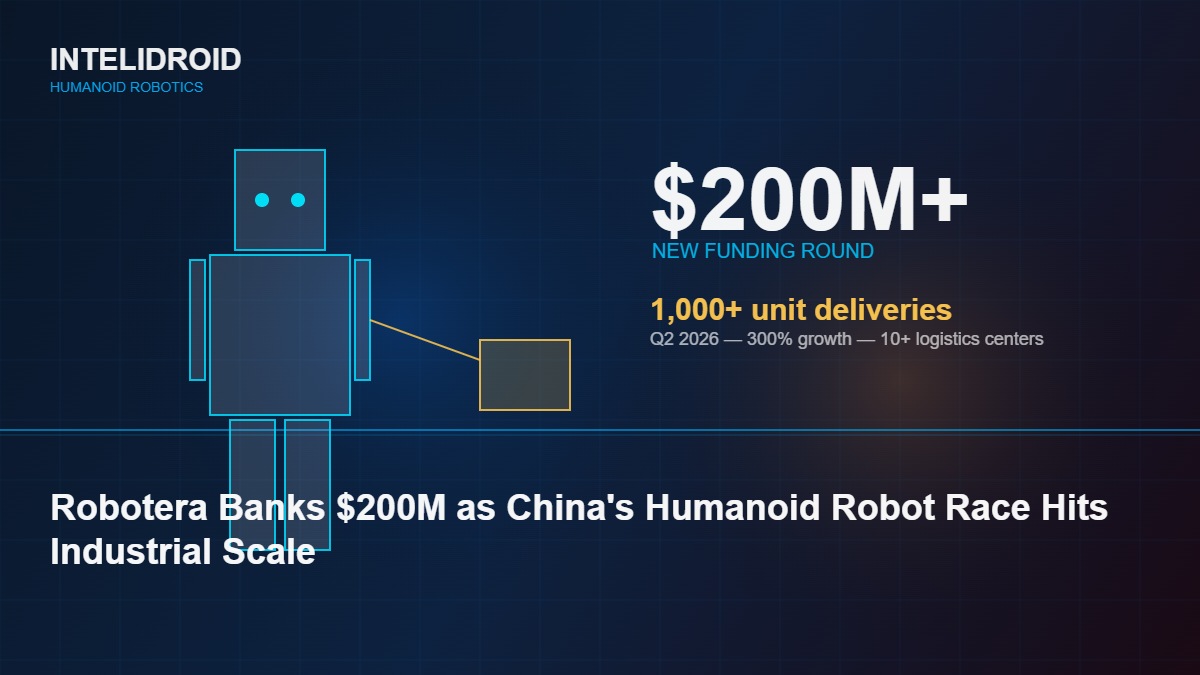
The humanoid robot money pipeline is no longer just about American startups raising billions on a video reel. On May 8, Beijing-based Robotera announced it had closed a new funding round of more than USD $200 million, led by Chinese shipping and logistics giant SF Group, with HSG, IDG Capital, Hillhouse Investment, CICC Capital and a long roster of strategic backers piling in. The round arrived just weeks after a separate RMB 1 billion (roughly $138 million) strategic raise — and, more importantly, alongside concrete numbers from the factory floor.
This isn’t another renderings-and-roadmap story. Robotera says it began thousand-unit deliveries in the second quarter of 2026, with quarter-over-quarter growth above 300%. That puts it firmly in the same conversation as Unitree, Agibot and UBTECH — the small group of Chinese humanoid makers now shipping in real volume.
A Logistics Heavyweight Leads the Round
The most revealing detail is who wrote the lead check. SF Group is one of the largest courier and supply-chain operators in Asia, with tens of thousands of distribution sites and a relentless labor problem. Strategic capital from SF means Robotera doesn’t just have money — it has a buyer with national-scale warehouses that need bodies on the floor. Press materials confirm that Robotera humanoids are already operating in more than 10 logistics centers through partnerships with both SF Group and China Post.
HSG (Sequoia Capital China) and IDG Capital, both veteran tech investors, anchor the financial side of the syndicate. The mix — strategic operator plus growth funds — is the same playbook that turned Chinese EV upstarts into global exporters in the early 2020s.
Vertical Integration: 95% of the Hardware Is In-House
Robotera’s competitive pitch leans hard on hardware. The company says it has built more than 95% of its core robotic components internally, spanning actuation systems, sensors and full humanoid platforms. Its flagship technology is what it calls a full direct-drive dexterous hand — the first of its kind in the industry, according to the company — designed for high-precision, durable manipulation in industrial environments.
For warehouse work, the hand is the bottleneck. Walking and balance are largely solved; reliable, low-maintenance manipulation of arbitrary objects is the wall that humanoids have been smashing into for two years. A direct-drive dexterous hand removes the gearboxes and tendons that have historically failed under repetitive industrial duty cycles. If Robotera’s design holds up under thousand-unit deployment data, it could become one of the defining hardware decisions of the cycle.
Why This Round Matters Beyond China
U.S. humanoid coverage has been dominated by Figure, 1X, Tesla Optimus, Apptronik and Agility. But the production-volume picture continues to shift east. China’s national industrial policy has explicitly named humanoid robotics as a strategic sector, and that policy is now translating into commercial revenue: SF Group buying Robotera units is essentially the same as if FedEx took a strategic position in Agility Robotics and started rolling Digits into its hubs.
A few things to watch as Robotera scales:
- Export pressure. Robotera’s direct-drive hand and full-stack hardware could make it a serious competitor in cost-sensitive markets outside China, particularly Southeast Asia and the Middle East.
- Data flywheel. Thousand-unit deployments in real logistics centers generate the kind of teleoperation and manipulation data that today’s foundation-model-driven robotics policies feed on. More fleet hours equals better policies equals more deployments.
- Tariff and procurement risk. Western customers, especially in defense-adjacent logistics, may struggle to source Chinese humanoids regardless of price-performance. Robotera’s growth story is likely a domestic-and-allied-markets story first.
Industrial Humanoids Are Becoming a Real Category
Through 2024 and 2025, the question “Are humanoids real?” was a fair one. In 2026, the question has shifted to “Whose humanoid will be working in your facility in 18 months?” Robotera’s raise — and the buyer-led structure of its cap table — is another data point that the answer increasingly involves a Chinese badge on the chest plate.
For the broader InteliDroid beat, the $200M+ round is less interesting as a financing event and more interesting as a commercial one. The capital is following the contracts, not the demos. When the lead investor is also the customer, the gap between announcement and deployment narrows to weeks.

Gatsby Sends a Humanoid Robot Into an American Home — History Made at $150

Figure AI’s Helix-02 Humanoids Sort 100,000 Packages in 81 Hours — No Human Required

Ollama Bleeding Llama Vulnerability Deepens Risks for Local AI Infrastructure

Ollama “Bleeding Llama” Vulnerability Exposes Critical Risks for Local AI Infrastructure

Robotera Banks $200M as China’s Humanoid Robot Race Hits Industrial Scale
Meta Acquires Assured Robot Intelligence: Physical AI Accelerates Into Homes and Factories

Tesla Optimus Gen 3: Mid-2026 Reveal Accelerates Humanoid Readiness

1X Technologies Launches America’s First High-Volume Humanoid Factory as NEO Preorders Sell Out in Days

The Imperative of Inclusion and Diversity in AI Humanoids: Cultivating Culturally Resonant Interactions

Humanoid Robots Steal the Spotlight at UN Artificial Intelligence Meeting

The Dawn of Intelligent Machines: Unveiling the Figure 01 Humanoid Robot

Sanctuary AI’s Humanoid Robot: Blurring the Lines between Humans and Machines

Principles of Freedom in the InteliDroid AI System: A Comprehensive Exploration

Key Principles and Ethical Considerations of Law as Incorporated into the InteliDroid AI Platform: A Question and Answer Guide

Figure AI’s Helix 02 Gives the Figure 03 Full-Body Autonomy — and It Just Did Your Dishes

BMW’s AEON Humanoid Robot Goes Live in Leipzig: Europe’s Factory Floor Just Changed Forever
-
 Robotic2 months ago
Figure AI’s Helix 02 Gives the Figure 03 Full-Body Autonomy — and It Just Did Your Dishes
-
 Robotic2 months ago
BMW’s AEON Humanoid Robot Goes Live in Leipzig: Europe’s Factory Floor Just Changed Forever
-

 Robotic2 months ago
Tesla Optimus Gen 3 Is Almost Here: Silhouette Revealed, Mass Production Set for Summer 2026
-
 Humanoid Robots1 month ago
Agility Robotics’ Digit Achieves Commercial Breakthrough: First Revenue-Generating Bipedal Humanoid in Warehouses
-
 Humanoid Robots1 month ago
China Leads the Charge: Agibot, Unitree, and UBTECH Set Humanoid Shipment Records
-

 Robotic2 months ago
China’s 2026 Humanoid Robot Half-Marathon: 300 Robots Race Alongside Humans on April 19
-
 Robotic2 months ago
Unitree H1 Hits 10 m/s: Humanoid Robot Closes In on Usain Bolt’s World-Record Pace
-
 Artificial Intelligence2 months ago
Meet Roadrunner: The RAI Hybrid That Swaps Between Legs and Wheels Zero-Shot