
Robotic
Unitree H1 Hits 10 m/s: Humanoid Robot Closes In on Usain Bolt’s World-Record Pace
On April 11, 2026, Unitree’s H1 humanoid robot reached a peak sprint speed of 10 m/s — putting it within striking distance of Usain Bolt’s world-record pace and setting a new benchmark for humanoid locomotion.

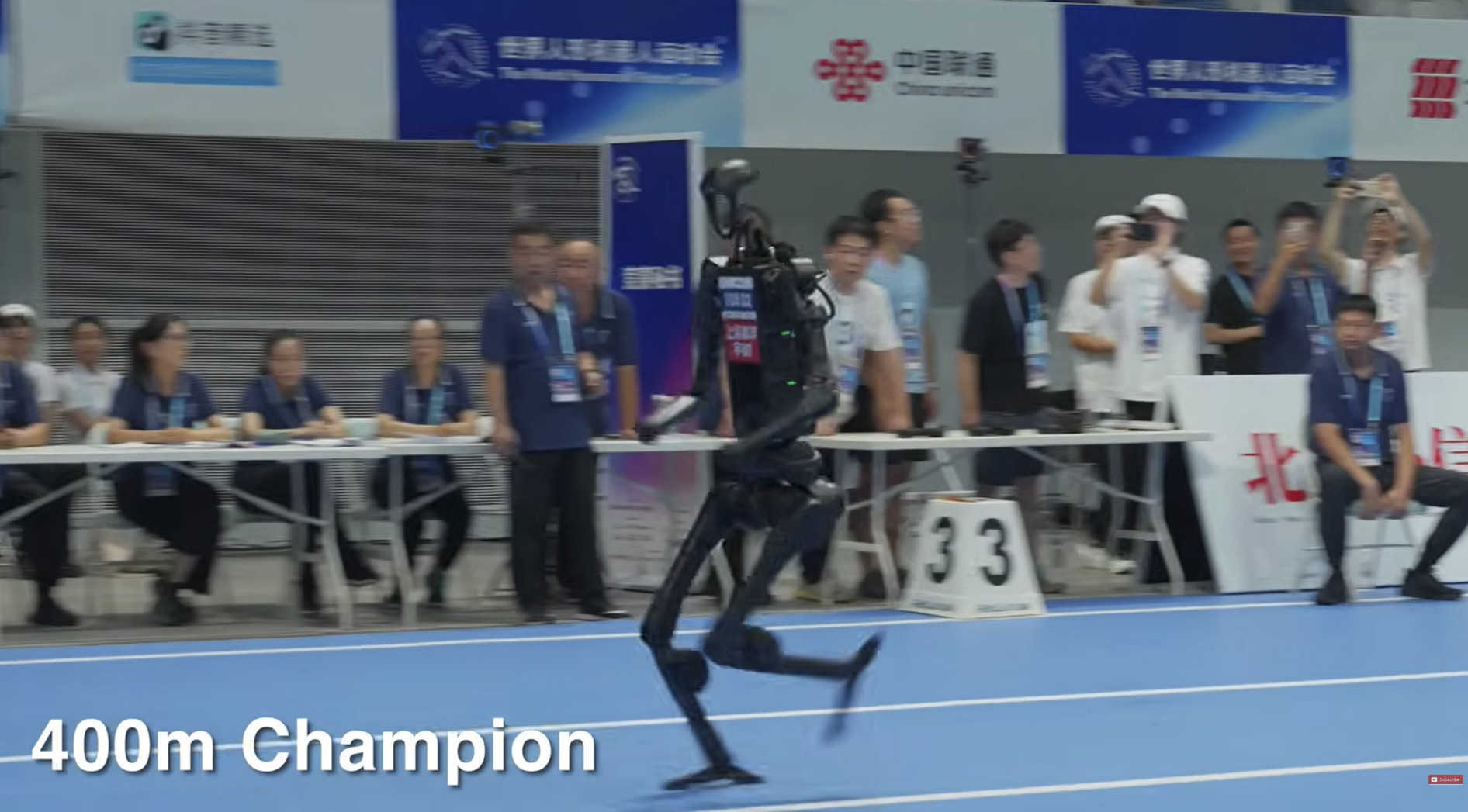
Something remarkable happened on April 11, 2026. Unitree Robotics released footage of its H1 humanoid robot sprinting at 10 meters per second — that’s 22.4 miles per hour. For context, Usain Bolt’s average speed during his 9.58-second 100-meter world record was 10.44 m/s. The gap between machine and mankind’s fastest human is now measured in fractions of a second per meter.
This isn’t just a robotics milestone. It’s a signal that the field is entering a new phase — one where humanoid robots don’t just move through environments, but move through them fast.
What the Unitree H1 Just Did
On April 11, Unitree posted a video of the H1 achieving a verified peak running speed of 10 m/s, with some measurement logs showing 10.1 m/s. The H1 stands 180 centimeters tall — roughly the height of an average adult male — and weighs approximately 62 kilograms in its current sprint configuration. With 19 degrees of freedom and joint torque peaking at 360 N·m, the robot has the mechanical foundation for aggressive dynamic motion, but reaching 10 m/s requires more than just powerful actuators. It demands precise balance, split-second gait control, and real-time adaptation — all at a velocity where any stumble becomes a crash.
The achievement technically ties or surpasses the previous humanoid record, set just two months earlier in February 2026 by Chinese startup MirrorMe. Their robot, aptly named “Bolt,” also reached 10 m/s — but MirrorMe’s platform stands 175 cm and weighs 75 kg. The Unitree H1’s lighter configuration and taller frame make its record particularly notable from an engineering standpoint.
Putting 10 m/s in Perspective
Speed comparisons help frame just how far humanoid locomotion has come. Tesla’s Optimus robot currently tops out at around 2.7 m/s. RobotEra’s STAR1 reaches about 3.6 m/s. Most legged robots from major research institutions operate comfortably between 2 and 5 m/s. The Unitree H1’s 10 m/s sprint isn’t just faster — it’s in a different category.
Compare this to humans: a brisk jog is around 3 m/s, a competitive amateur runner peaks near 7–8 m/s, and elite sprinters reach 10–11 m/s. Usain Bolt’s absolute peak during his 100m record was measured at approximately 12.42 m/s. The H1 is now operating at roughly 80% of that peak — the functional sprint range of a very fast human athlete.
Unitree has gone on record suggesting that humanoid robots will eventually surpass human sprint records entirely. Given the trajectory, that prediction no longer sounds like speculation.
Why Speed Is About More Than Speed
It would be easy to dismiss a fast-running robot as an impressive but impractical demonstration. That misses the point. High-speed locomotion is a proxy for a set of capabilities that matter enormously in real-world robotics deployment.
To run at 10 m/s, the H1’s control systems must handle rapid terrain feedback, manage dynamic stability during airborne phases, and coordinate dozens of joints within milliseconds. These are the same systems — scaled down in intensity — that enable smooth walking across uneven surfaces, recovering from unexpected pushes, navigating cluttered environments, and operating in facilities where precise, reactive movement is non-negotiable.
Applications like emergency response, disaster relief, industrial inspection, and autonomous warehousing all benefit from platforms that move with speed and confidence. A robot that can sprint is a robot whose locomotion stack has been pushed to its limits and stress-tested beyond everyday demands.
Unitree’s Broader Momentum in 2026
The speed record doesn’t exist in isolation. Unitree has been on an extraordinary run — in every sense of the word. The company shipped more than 5,500 humanoid robots in 2025 and is projecting between 10,000 and 20,000 units in 2026. Their G1 model, which launched at $16,000, helped make humanoid robotics financially accessible to research labs, startups, and enterprises for the first time.
With the H1 now setting the global sprint benchmark, Unitree is positioning itself as both the volume leader and the performance leader in the humanoid space — a rare dual distinction in any technology sector. The company’s willingness to push the boundaries of what their robots can do physically, and to document those efforts publicly, has made them one of the most closely watched players in global robotics.
The Race Is Just Getting Started
The Unitree H1’s 10 m/s sprint is a headline that will age quickly. In this field, records fall on timelines measured in months, not years. MirrorMe will refine Bolt. Boston Dynamics will push Atlas further. Chinese labs, European research institutes, and Silicon Valley startups are all chasing the same locomotion targets.
What matters isn’t just who holds the record today — it’s that the entire performance envelope of humanoid robotics is expanding at a pace that the industry itself didn’t predict. At InteliDroid, we’re watching this acceleration closely, because the robots being built and broken and rebuilt today are the foundation of the machines that will share our factories, hospitals, and streets tomorrow.
When a humanoid robot can close in on Usain Bolt, the future isn’t coming. It’s already running.
Robotic
Boston Dynamics Drops the Pinky: Atlas Gets a 13-DoF Hand Built for the Factory Floor
Boston Dynamics unveiled a four-finger, 13-degree-of-freedom hand for Atlas, designed for tool use, sim-to-real learning and a 25,000-robot deployment across Hyundai and Kia plants.
Boston Dynamics has spent nearly a decade proving Atlas can run, jump and backflip. Now it is betting the robot’s commercial future on something far less flashy: a hand with only four fingers.
On October 1, the Hyundai-owned company unveiled a redesigned Atlas hand with 13 degrees of freedom, nearly double the seven of its predecessor, and deliberately no pinky. In demo footage, Atlas loads a bit into a power drill, drives it into wood, tightens a small nut by fingertip and rotates two golf balls independently inside a single palm. The message is clear: the walking problem is solved, and the hand is where the humanoid race will be won or lost.
Why Boston Dynamics dropped the pinky
Almost every competing humanoid program has converged on five-fingered hands that mimic human anatomy as closely as possible. Boston Dynamics went the other way after what sounds like a remarkably low-tech experiment. Chief product and technology officer Zachary Jackowski asked the Atlas team to tape their pinky and ring fingers together for a day and report what they could no longer do. The answer, for most practical tasks, was very little.
Mechanical engineer Dylan Thrush explained the trade-off to The Robot Report: a fifth finger would add three more degrees of freedom, more mass, more power draw and more components to fail, without unlocking enough additional grasps to justify the cost. The four-finger layout still delivers the grips a factory floor actually demands, including:
- Pinch grasps between the thumb and any individual finger
- Tripod grasps across three fingers for holding irregular parts
- Sliding the thumb along and across every other finger for in-hand reorientation
- Triggered tool grasps for drills, torque drivers, grinders, nail guns and welding torches
The thumb alone carries four degrees of freedom and can oppose each of the three remaining fingers, while the hand itself is sized like a large human hand so Atlas can fit into workstations and use tools that were never designed for a robot.
Built for simulation first
The most interesting part of the design is not what you can see but what it was optimized for. Boston Dynamics says the hand was built from the ground up for sim-to-real reinforcement learning. Every joint uses a single type of directly actuated, fully encapsulated actuator with no cables crossing the joints, the same philosophy as the rest of the Atlas body. The result is a mechanism that can be simulated with high dynamic fidelity, which in turn lets the company train control policies against randomized friction, torque profiles, object geometries and disturbances before they ever touch hardware.
Alberto Rodriguez, director of robot behavior for Atlas, framed the design as a balance of competing goals rather than a search for a single right answer. Human demonstration data, captured through wearable interfaces, is good at teaching a robot what a task looks like. But fast, dexterous manipulation also depends on high-rate force control that wearables cannot capture. That gap is why Boston Dynamics believes reinforcement learning in simulation is essential, and why the hand’s backdrivable actuators and dense pressure sensors across the fingertips and palm matter so much. Early results, the company says, show promising transfer of dynamic behaviors trained purely in simulation onto the physical robot.
A hand with a job waiting for it
This is not a research curiosity in search of an application. The announcement landed one week after Boston Dynamics opened its Robotics Metaplant Application Center inside Hyundai Motor Group Metaplant America near Savannah, Georgia. Atlas units there are learning to sort and sequence automotive parts before they reach the assembly line, with component assembly targeted for 2030.
Hyundai and Kia have committed to deploying 25,000 Atlas robots across their global plants over the coming years, and Hyundai has said it intends to build a U.S. factory capable of producing up to 30,000 robots annually by 2028. Since Hyundai took full ownership of Boston Dynamics earlier this year, the Atlas pipeline is less a partnership than an internal supply-chain decision. The emphasis on manufacturability and repairability, a single actuator type, no fragile cables, a design meant to be serviced by a line technician, tells you exactly who this hand was built for.
The hand is the new bottleneck
Step back and a pattern emerges across the industry. Tesla’s Optimus Gen 3 is reportedly chasing 22 degrees of freedom per hand with tendon-driven actuators moved into the forearm. Figure 03 pairs palm cameras with fingertip sensors sensitive to a few grams of pressure. Unitree just put its 22-joint Dex5-S hand on sale for $6,500. Three very different companies, with very different philosophies, have all reached the same conclusion: the legs are good enough, and the hand is what stands between a demo and a shift.
Boston Dynamics’ answer is contrarian. Instead of maximizing degrees of freedom, it is minimizing complexity while keeping just enough dexterity to use real tools. Whether four fingers beat five will be decided not on a stage but on a Georgia factory floor over the next few years. For a field that has been measured by backflips for far too long, that is exactly the right place to settle the question.
Humanoid Robots
ugo Nova: Japan’s Homegrown Bet on Physical AI
Japanese firm ugo has unveiled Nova, a fully domestic dual-arm semi-humanoid built to turn everyday human work into training data for physical AI, with mass production slated for 2027.
While the humanoid headlines this month have been dominated by robots moving into people’s living rooms, a Japanese company just made a quieter—but arguably more strategic—move. On September 16, ugo Inc. unveiled ugo Nova, a semi-humanoid robot designed, engineered, and manufactured entirely in Japan and aimed squarely at one of robotics’ hardest bottlenecks: data. Rather than chasing viral backflips, Nova is built to do ordinary work while quietly recording every motion, turning human labor into fuel for the next generation of physical AI.
Meet Nova: A Semi-Humanoid Built for Work, Not Show
Nova is not a bipedal walker. It pairs a wheeled mobile base with a humanlike upper body: two seven-degree-of-freedom arms, a four-degree-of-freedom waist, and 22 degrees of freedom across the system. Standing 162 centimeters tall and weighing 90 kilograms, it is sized for the same doorways, workbenches, and counters that people use every day.
That “semi-humanoid” choice is deliberate. By skipping the enormous engineering cost and instability of dynamic legged locomotion, ugo can focus its budget on precise, dexterous manipulation and reliable, stable operation in real workplaces. The result is a platform that trades athletic spectacle for something more useful in the near term: a robot that can actually show up and get things done.
A Robot Designed to Be a Data Engine
Nova’s real purpose becomes clear once you look at how it is instrumented. Cameras are mounted as standard on both the head and the hands, capturing the visual data needed to train physical AI from the moment the robot is set up. Every task it performs can be converted directly into high-quality learning data for building robot foundation models.
Crucially, Nova is built for teleoperation. Operators can drive it using bilateral controllers and VR controllers, with arm control running at a high 100 Hz cycle so that movements are recorded smoothly and with high precision. A human guides the robot through a task—drilling, fastening, handling parts—and the system captures that demonstration as clean, structured training data. In its public demonstration, Nova performed a drilling task under remote control, exactly the kind of repetitive, physical job that is hard to simulate but easy to teach by example.
ugo announced Nova alongside a companion offering it calls the ugo Physical AI Fabric, a package that spans everything from data collection to foundation-model development. The message is that Nova is not just a robot, but one end of a full pipeline connecting real-world demonstrations to trained AI and, ultimately, to commercial deployment.
Why “Made in Japan” Matters Here
Nova arrives as part of a broader national push. The robot is being proposed by the AI Robot Association (AIRoA) under a project commissioned by NEDO, Japan’s New Energy and Industrial Technology Development Organization, to develop a domestically produced general-purpose robot. It was revealed at an event where prototypes from several Japanese companies were shown together—a coordinated signal that Japan intends to build homegrown hardware for the physical AI era rather than depend entirely on imported platforms.
For a country facing labor shortages and an aging workforce, a domestic, general-purpose robot that can be trained on local tasks is more than a tech demo; it is industrial strategy. Controlling the hardware, the data pipeline, and the models keeps critical capability—and the sensitive operational data that comes with it—inside the country.
The Takeaway
With mass production targeted for 2027, ugo Nova won’t flood workplaces overnight. But it reflects a shift that InteliDroid has tracked all year: the humanoid race is increasingly a race for data. The winners may not be the robots that move most impressively, but the ones that learn fastest from real human work. Nova is a bet that the shortest path to capable, general-purpose robots runs through thousands of hours of ordinary tasks—recorded, structured, and fed back into ever-smarter models. It is a distinctly Japanese answer to the physical AI question, and one worth watching as 2027 approaches.
Robotic
UBTech’s UWORLD U1 Companion Humanoid Begins Shipping to Chinese Homes
UBTech begins delivering its UWORLD U1 on September 16 — a China-only, companionship-focused humanoid priced from roughly $16,500 to $137,000, with more than 13,000 preorders already booked.
On September 16, one of the year’s most closely watched consumer robots stops being a preorder and becomes a product you can actually take home. That is the day UBTech begins mass production and delivery of the UWORLD U1, the full-size humanoid it is pitching not as a household worker but as a companion. After more than 13,000 reservations, the U1 is about to test whether ordinary buyers are ready to live alongside a two-legged robot.
A companion, not a chore-bot
UBTech has been unusually blunt about what the U1 is not. Speaking at the launch, founder and CEO Zhou Jian told the audience the robot is built for emotional companionship, not labor: it does not clean, it does not cook, and it is sold only to adults. Interaction data is stored locally on the device, with no mandatory upload to the cloud, a deliberate answer to the privacy anxieties that shadow any always-listening machine in the home.
That positioning sets the U1 apart from most of the humanoids making headlines this year, which chase warehouse, factory, and logistics work. Instead of competing on how many packages it can sort, the U1 competes on presence, conversation, and the novelty of a life-sized robot that reacts to the people around it.
Three robots, three very different price tags
UWORLD, UBTech’s new consumer brand, is launching the U1 in three tiers so the concept can reach both curious early adopters and deep-pocketed collectors:
- U1 Lite — a half-body model at 119,800 yuan (roughly $16,500), the entry point into the lineup.
- U1 Pro — a full-body version at 169,800 yuan (about $23,500).
- U1 Ultra — the high-dynamic flagship, offered in two variants priced at 880,000 and 990,000 yuan (roughly $122,000 to $137,000).
The spread is enormous, but it reflects a bet that “companion humanoid” can be a category with a mass-market floor and a luxury ceiling, much like the early car or smartphone markets before them.
13,000 orders and a China-only rollout
Demand has already outpaced expectations. Presales opened on JD.com in early June and cleared 1,000 reservations within three days; by the June launch event, cross-channel orders had reached 13,361 units. UBTech is targeting more than 10,000 deliveries for the full year and has promised every preorder holder a unit by December 31, 2026.
For now, the rollout is limited to mainland China. That keeps the U1 out of reach for buyers in the U.S. and Europe, but it also concentrates a remarkable amount of real-world deployment in a single market, exactly the kind of scale that turns a flashy demo into a maturing product line.
Why the U1 matters for the wider industry
The timing is telling. Humanoid shipments surged roughly 272% year over year in the first half of 2026 to an estimated 19,000 to 22,000 units, with Chinese manufacturers accounting for the overwhelming majority. The U1 is both a symptom and a driver of that curve: it moves humanoids out of controlled industrial pilots and into living rooms, where reliability, safety, and everyday usefulness are judged by non-experts.
Whether buyers keep their U1 switched on a year from now is the real experiment. If UBTech can turn 13,000 preorders into 13,000 satisfied households, it will have proven something the entire sector has only promised so far — that a humanoid robot can earn a permanent place in an ordinary home. At InteliDroid, we will be watching September 16 closely, because the first wave of deliveries is where the companion-robot era stops being a pitch and starts being a track record.

Boston Dynamics Drops the Pinky: Atlas Gets a 13-DoF Hand Built for the Factory Floor

ugo Nova: Japan’s Homegrown Bet on Physical AI

UBTech’s UWORLD U1 Companion Humanoid Begins Shipping to Chinese Homes

Robots Take the Oval: Inside Beijing’s 2026 World Humanoid Robot Games

Unitree Goes Public: China’s First Listed Humanoid Robot Maker Prices Its IPO at a $9 Billion Valuation

BYD Joins the Humanoid Race: Meet “Xiao Di,” the Robot Headed for Its Showrooms

URKL Debuts in Shenzhen: The World’s First Autonomous Humanoid Combat League

Germany’s NEURA Robotics Lands $1.4 Billion From Amazon, Nvidia, and Tether — The Largest Humanoid Funding Round Ever

The Imperative of Inclusion and Diversity in AI Humanoids: Cultivating Culturally Resonant Interactions

Humanoid Robots Steal the Spotlight at UN Artificial Intelligence Meeting

The Dawn of Intelligent Machines: Unveiling the Figure 01 Humanoid Robot

Agility Robotics’ Digit Achieves Commercial Breakthrough: First Revenue-Generating Bipedal Humanoid in Warehouses

Sanctuary AI’s Humanoid Robot: Blurring the Lines between Humans and Machines

Principles of Freedom in the InteliDroid AI System: A Comprehensive Exploration

Key Principles and Ethical Considerations of Law as Incorporated into the InteliDroid AI Platform: A Question and Answer Guide

Figure AI Ramps Figure 03 Production to One Per Hour: Humanoid Manufacturing Milestone
-
 Humanoid Robots2 months ago
Unitree Goes Public: China’s First Listed Humanoid Robot Maker Prices Its IPO at a $9 Billion Valuation
-
 Humanoid Robots3 months ago
URKL Debuts in Shenzhen: The World’s First Autonomous Humanoid Combat League
-
 Robotic2 months ago
BYD Joins the Humanoid Race: Meet “Xiao Di,” the Robot Headed for Its Showrooms
-
 Robotic1 week ago
Boston Dynamics Drops the Pinky: Atlas Gets a 13-DoF Hand Built for the Factory Floor
-
 Robotic4 weeks ago
UBTech’s UWORLD U1 Companion Humanoid Begins Shipping to Chinese Homes
-
 Robotic2 months ago
Robots Take the Oval: Inside Beijing’s 2026 World Humanoid Robot Games
-
 Humanoid Robots3 weeks ago
ugo Nova: Japan’s Homegrown Bet on Physical AI