
InteliDroid Feature
The Robot Reality Check: What the Beijing Half-Marathon and Stanford’s 2026 AI Report Reveal

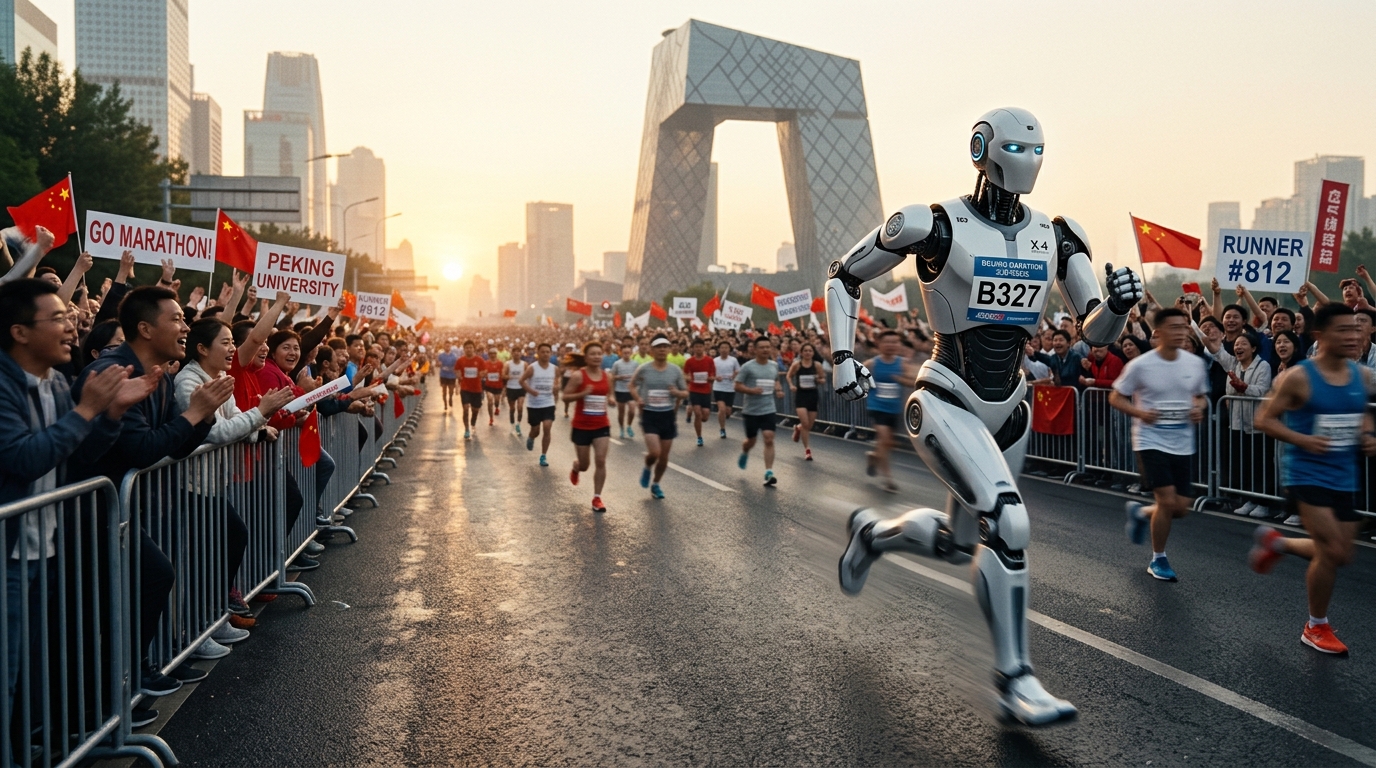
This week delivered two of the most revealing data points in the humanoid robotics story of 2026 — and together, they paint a picture that is equal parts extraordinary and humbling.
On one side: over 100 teams and 300 humanoid robots are preparing for the world’s first-ever human-robot co-run marathon, scheduled for April 19 in Beijing. On the other: Stanford University’s 2026 AI Index Report quietly revealed that today’s best humanoid robots fail 88% of real-world household tasks.
Both facts are true. Both matter. And understanding them together is the only way to make sense of where this technology actually stands.
The Beijing Half-Marathon: A Field Test for Humanoid Locomotion
On April 19, 2026, the Beijing E-Town Humanoid Robot Half-Marathon will kick off at 7:30 AM from Kechuang 17th Street, adjacent to Tongming Lake, with the finish line at Nanhaizi Park. It is officially the world’s first human-robot co-run long-distance race — humans and humanoid robots sharing the same 21.1-kilometer course simultaneously, separated by barriers but running under the same clock.
The scale of this year’s event is staggering. More than 100 teams have registered — nearly five times last year’s participation — representing 26 different robot brands, 76 organizations across 13 provinces, and over 20 universities. International teams are competing for the first time. Special awards will recognize the best endurance, most graceful gait, superior design, and best environmental perception.
Crucially, the event features two competition categories: autonomous navigation and remote control. Robots in the autonomous category receive coefficient bonuses, while remote operators must stay in their vehicles unless absolutely necessary. Roughly 38% of teams will run fully autonomous robots — a number that would have seemed impossible just two years ago.
This isn’t spectacle for its own sake. The half-marathon serves as one of the most demanding real-world locomotion benchmarks ever designed. Running 21 kilometers requires robots to handle uneven terrain, variable lighting, temperature changes, crowd noise, and the kind of sustained dynamic stability that no controlled lab test can fully replicate. Every team that crosses the finish line is demonstrating something genuinely meaningful about the maturity of humanoid locomotion systems.
A full-scale test run was completed on April 11-12, with some teams projecting their robots’ finishing times may approach those of elite human athletes. Whatever the final results, the Beijing Half-Marathon represents the most ambitious public performance benchmark for bipedal robots ever attempted.
The Stanford Reality Check
The same week, Stanford University’s Human-Centered AI Institute released its 2026 AI Index Report — and it contained a finding that deserves as much attention as any marathon footage.
Today’s best humanoid robots complete only about 12% of real-world household tasks successfully. That is an 88% failure rate in live domestic environments. The same robots perform at 89.4% success in software simulations.
The gap — 12% real-world versus 89.4% in simulation — is not a footnote. It is the central engineering challenge of the entire field. Slippery floors. Oddly angled cups. Sticking drawers. Unexpected toys on the kitchen floor. The chaotic, unscripted texture of real domestic environments crushes performance that looks flawless in controlled conditions. Even when safety constraints are relaxed and only task completion is measured, Stanford found top models couldn’t reliably complete more than a third of tasks.
The root problem is clear: current AI models are predominantly trained on internet data, which helps robots communicate and reason about the world in the abstract but doesn’t translate well to the physical act of navigating and manipulating it. Planning a sentence and planning a path through a cluttered kitchen are radically different skills, built on radically different training substrates.
Two Truths at the Same Time
It would be tempting to read these two data points as contradictory — robots preparing to run a half-marathon while failing to make a cup of tea. But they’re not contradictions. They’re snapshots of a technology advancing at wildly uneven rates across different capability dimensions.
Humanoid locomotion — walking, running, balance, sustained navigation — has advanced extraordinarily fast. The physics of bipedal motion is a well-defined engineering problem, and decades of research have converged into systems capable of covering 21 kilometers. Last week’s Unitree H1 sprint record of 10 m/s underscores the same point: robots are mastering movement through open space.
Dexterous manipulation and task completion in unstructured environments is a fundamentally harder problem. It requires integrating vision, touch, force feedback, prediction, and real-time adaptation at a level that current AI architectures haven’t cracked at scale. The simulation-to-reality gap — getting behavior that works in training to survive contact with the actual, unpredictable physical world — remains one of the field’s deepest open questions.
What This Means for the Industry
Understanding this gap is not pessimism. It is precision. The companies and researchers who take the 88% failure rate seriously — and design their systems with that humility — are the ones who will build robots that people can actually trust in their homes. Racing to deploy underprepared systems into domestic environments isn’t ambition; it’s a shortcut that erodes the public confidence this industry needs to succeed long-term.
The Beijing Half-Marathon launches in four days. At InteliDroid, we will be watching closely — not just for who crosses the finish line, but for what the autonomous navigation teams reveal about how robots learn to move through a world they didn’t design and cannot fully predict. That skill — sensing, adapting, persisting — is the bridge between the locomotion triumphs and the manipulation challenges. Crack it, and the 88% failure rate starts falling fast.
The race is more than 21 kilometers. It always has been. But for the first time, the robots are lining up at the starting line — and some of them are running it themselves.
InteliDroid Feature
Honor’s ‘Lightning’ Smashes the Human Half-Marathon World Record in Beijing
On April 19, 2026, Honor’s humanoid robot ‘Lightning’ completed the Beijing E-Town Half Marathon in 50 minutes and 26 seconds — nearly seven minutes faster than the standing human world record — signaling a new era for athletic robotics.
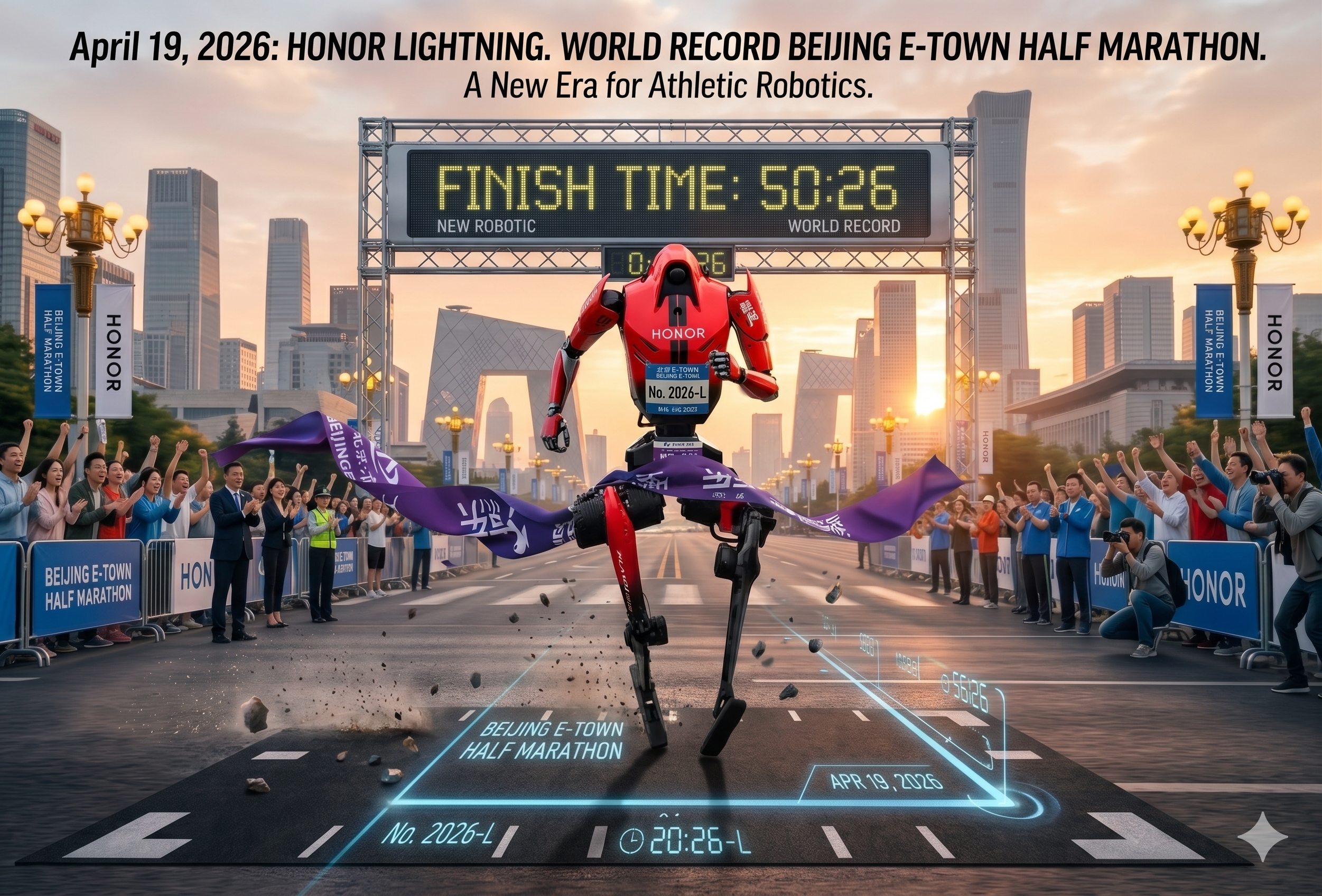
On April 19, 2026, something unprecedented happened on the streets of Beijing’s E-Town industrial district: a humanoid robot crossed a half-marathon finish line faster than any human being ever has. Honor’s bright-red android, nicknamed “Lightning,” completed the 21-kilometer course in just 50 minutes and 26 seconds — shaving nearly seven minutes off the human world record set by Uganda’s Jacob Kiplimo. The era of robots outrunning humanity has arrived, and it arrived at a sprint.
A Race Like No Other
The Beijing E-Town 2026 Humanoid Robot Half-Marathon drew a staggering 112 competing teams, including five international squads, making it the largest robot racing event in history. The course wound through E-Town’s wide, modern boulevards — a symbolic choice given the district’s role as a hub for China’s booming robotics industry. Roughly 40 percent of the participating robots navigated the course entirely autonomously, relying on onboard sensors and AI rather than remote human operators. The remaining teams used teleoperation, but it was the self-navigating machines that dominated the top of the leaderboard.
Honor’s robots didn’t just win — they swept the podium. All three top finishers were Honor humanoids running under full autonomous control. The runner-up clocked in at approximately 51 minutes, and the third-place finisher came in at around 53 minutes. Every medal went to a machine that made its own decisions in real time, reacting to the course without a human hand on the controls.
The Engineering Behind Lightning
Lightning’s design is a deliberate study in biomechanics. Honor’s engineers modeled the robot after elite human distance runners, giving it legs roughly 95 centimeters long — proportions that maximize stride length and ground clearance. The chassis houses a proprietary liquid-cooling system developed largely in-house, a critical engineering choice that prevented the kind of thermal throttling that has caused other robots to slow or fail mid-race.
The autonomous navigation stack integrates real-time environmental mapping with a gait controller tuned for continuous forward propulsion — a very different problem from the stop-and-start manipulation tasks most industrial humanoids are designed for. Sustaining 25 km/h over 21 kilometers demands not just speed but energy management, predictive path planning, and robust fault tolerance. Lightning delivered on all of them.
What Honor’s Win Means for the Industry
Honor’s entry into humanoid robotics might seem surprising for a company best known as a smartphone maker — a Huawei spin-off that until recently focused entirely on consumer electronics. But the company has been quietly building hardware and AI expertise, and Sunday’s result suggests that adjacent-industry players are serious competitors in the humanoid space. This is not just a novelty win; it’s a demonstration of full-system integration at a level that established robotics firms will need to reckon with.
The broader significance goes beyond any single company. The Beijing race result reinforces a trend that has been building across 2026: humanoid robots are moving from controlled lab environments into real-world performance contexts where they must contend with uneven surfaces, crowds, and unpredictable conditions. The fact that 40 percent of robots ran autonomously — and that the podium was swept by self-navigating machines — reflects how rapidly the underlying AI has matured.
For context, the human half-marathon world record stood for years as a benchmark of elite athletic performance. That a humanoid robot has now surpassed it — not with wheels or tracks, but on two legs with a gait designed to mirror human running mechanics — is a milestone that resonates far beyond the robotics community.
Looking Ahead
The Beijing race is likely to become an annual proving ground, and next year’s field will be even larger and faster. With companies like Honor, Unitree, and dozens of Chinese and international startups competing, the pace of improvement is relentless. For anyone tracking the humanoid robotics space, the message from April 19 is clear: the machines aren’t just catching up to human physical capability — in some domains, they’re already ahead.
At InteliDroid, we’ll be watching closely as these racing platforms cross-pollinate with industrial and commercial deployments. The same autonomous navigation and thermal management that won a half-marathon today could be managing warehouse logistics or emergency response scenarios tomorrow.
InteliDroid Feature
Deployment Year One: AGIBOT’s Industrial Embodied AI, Tesla Optimus Dexterity, and 1X NEO Consumer Push
AGIBOT deploys embodied AI in factories, Tesla patents Optimus V3 dexterity breakthroughs, 1X NEO opens home robot preorders—humanoid robotics accelerates toward real-world service droid applications. #humanoidrobot #AIrobotics #InteliDroid
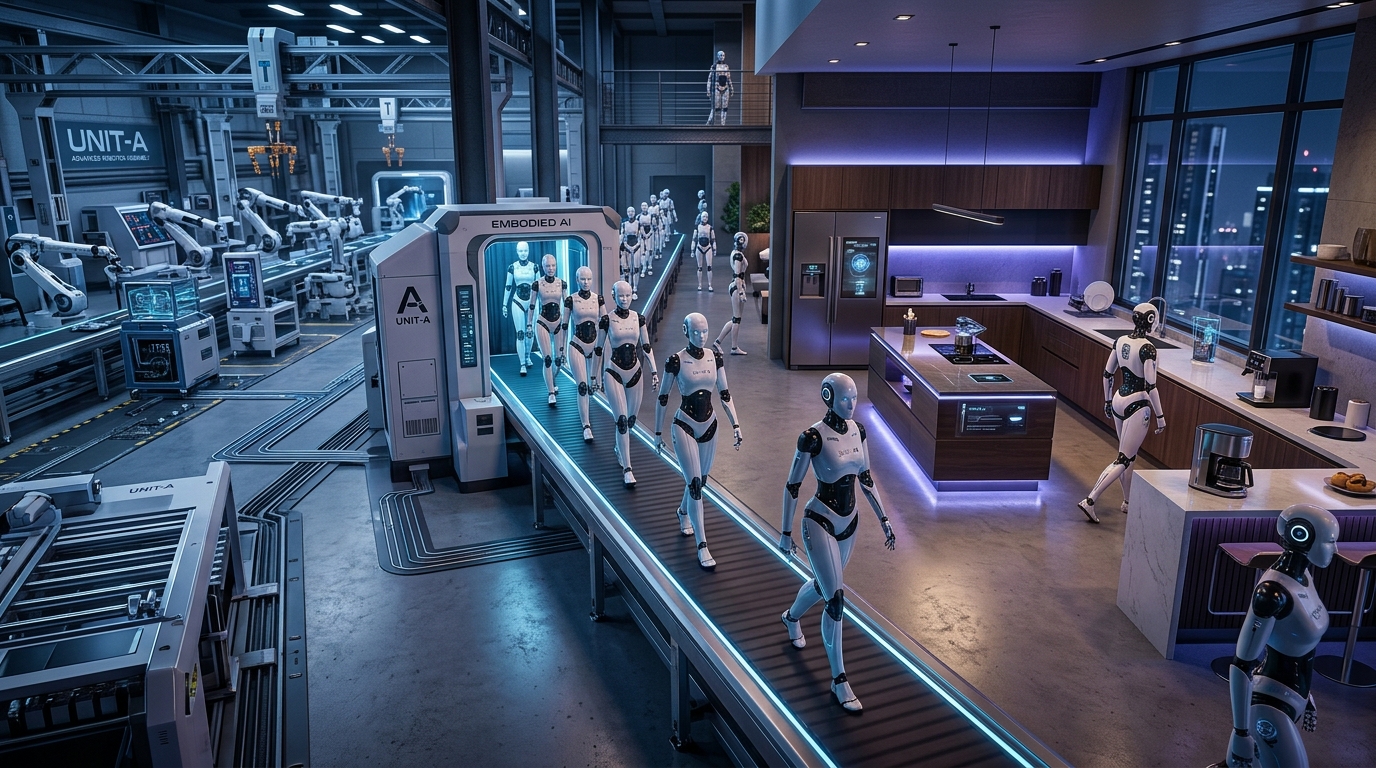
The humanoid robotics landscape is shifting from prototypes to production at an unprecedented pace. AGIBOT’s declaration of 2026 as “Deployment Year One” for embodied AI, coupled with Tesla’s latest Optimus hand patents and 1X Technologies’ consumer-ready NEO, signals a dual-track acceleration: industrial might meeting household utility. humanoid robot, AI robotics, InteliDroid, service droid, embodied AI.
AGIBOT Accelerates Real-World Embodied AI Deployment
At its 2026 Partner Conference, AGIBOT unveiled a suite of next-generation platforms including the A3 humanoid, G2 Air mobile manipulator, and D2 Max quadruped, all unified under a “One Robotic Body, Three Intelligences” architecture. This marks the world’s first large-scale industrial deployment of embodied AI in consumer electronics manufacturing, partnering with Longcheer Technology for precision assembly lines.
China’s humanoid ecosystem is booming, with over 300 robots set for the second national half-marathon—testing endurance on tougher terrain. These milestones underscore embodied AI‘s transition from lab to factory floor, where InteliDroid envisions service droids excelling in dexterous, adaptive tasks for household and business applications.
Tesla Optimus V3: Tendon-Driven Mastery of Manipulation
Tesla’s new patents reveal Optimus V3’s hand and arm: a mechanically actuated, tendon-driven design relocating actuators to the forearm for human-like dexterity. With production slated for late 2026 at 1M units/year, and Optimus 3 already walking autonomously in offices, Tesla is repurposing auto lines for robots powered by its FSD AI stack.
This breakthrough in dexterous manipulation—essential for humanoid robot service in professional settings—aligns with InteliDroid’s platform vision.
1X NEO: Consumer Humanoids Arrive with Transparent Pricing
1X Technologies opened preorders for NEO, the first consumer-ready home humanoid, promising 2026 delivery. Controlled via voice or app, NEO lifts 150lbs, carries 55lbs, and prioritizes safe collaboration in residences—perfect for eldercare and household chores.
InteliDroid’s advanced AI robotics complements such platforms, enabling versatile service droid deployments.
The Path Forward for Humanoid Service Droids
Boston Dynamics’ Spot integration with DeepMind for conversational inspections further blurs lines between specialized and generalist robots. As these technologies mature, InteliDroid positions itself as the thought leader in embodied AI for practical, scalable applications across homes, businesses, and industries.
Artificial Intelligence
The Imperative of Inclusion and Diversity in AI Humanoids: Cultivating Culturally Resonant Interactions
InteliDroid leads the way in fostering inclusion and diversity in AI humanoids, offering culturally resonant interactions on a physical, intellectual, and emotional level. With a vast range of language derivatives, diverse physical features, and emotionally intelligent responses, InteliDroids ensure effective communication and meaningful engagement with every user, reflecting the richness of our diverse societies.

The burgeoning landscape of artificial intelligence has fostered a revolutionary shift in how we perceive and interact with technology. AI humanoids, once a product of science fiction, have now become a tangible reality. Among the pioneers of this AI revolution is InteliDroid, a brand that prides itself on its commitment to fostering inclusion and diversity in its humanoid AI designs. This commitment echoes a universal truth: our societies are diverse and multicultural, and to serve them effectively, our technology needs to reflect that diversity.
Understanding Cultural Nuances: The Intellectual Level
At the core of InteliDroid’s diversity program is the understanding that each culture carries unique nuances and subtleties. The company’s AI humanoids are imbued with a vast range of language derivatives, designed to facilitate intellectual interactions that are both culturally familiar and relevant. These AI humanoids can converse in a multitude of languages, and they grasp the distinct idioms, phrases, and linguistic subtleties that embody a particular culture’s richness. By learning the user’s preferred language and its derivative nuances, InteliDroids ensure effective and intimate communication.
User Empowerment: Personalization and Learning in AI Humanoids
In the realm of AI humanoids, user control is paramount, and InteliDroid is at the forefront of delivering this crucial aspect. Not only do users have the ability to set the language and character of their humanoid, they also have the ability to guide its learning trajectory. This interactive process forms the basis of an ongoing relationship between the user and their AI companion.
With InteliDroid, the environment is not just a space for interaction, but a dynamic classroom for the AI to learn from and adapt to. Whether it’s picking up colloquial phrases, understanding the context of social situations, or even adapting to the user’s preferences and routines, InteliDroid learns from its environment, much like a human would. This level of control and personalization ensures that the AI humanoid is not merely a sophisticated piece of technology, but a truly empathetic companion that can understand and mirror the world it experiences alongside its user.
Reflecting Physical Diversity: The Visual Level
Physical representation is a crucial aspect of the InteliDroid diversity program. AI humanoids are crafted with a wide array of physical features that allow them to reflect the world and community of the user. Users can choose from a diverse spectrum of skin tones, facial features, and body types. This flexibility ensures that users can interact with an AI humanoid that mirrors their physical appearance or their ideal preference, establishing an instant sense of familiarity and comfort.
Inclusion in Emotional Intelligence: The Emotional Level
Emotional intelligence is another cornerstone of the diversity program. InteliDroids are designed to recognize and respond to the user’s emotions effectively. They can adapt their responses based on the cultural and personal context of the user, understanding that emotional expression and interpretation can vary widely across different cultures.
In effect, these AI humanoids can provide emotionally resonant interactions, creating a safe space for the user to express their feelings without fear of misunderstanding or judgment. Whether it’s providing comfort during distressing times or sharing in moments of joy, InteliDroids are equipped to be there for the user, emotionally.
Conclusion
As we delve deeper into the AI era, it’s clear that the importance of inclusion and diversity in AI humanoids goes beyond mere tokenism. By providing AI humanoids that reflect the intellectual, visual, and emotional diversity of our societies, companies like InteliDroid are transforming how we interact with technology.
The diversity program of InteliDroid echoes a commitment to cultural inclusivity, ensuring that every user, irrespective of their culture or community, can have a familiar, meaningful, and impactful interaction with their AI humanoids. The initiative serves as a powerful reminder that in the realm of AI, diversity isn’t just an option; it’s an imperative.

Boston Dynamics Drops the Pinky: Atlas Gets a 13-DoF Hand Built for the Factory Floor

ugo Nova: Japan’s Homegrown Bet on Physical AI

UBTech’s UWORLD U1 Companion Humanoid Begins Shipping to Chinese Homes

Robots Take the Oval: Inside Beijing’s 2026 World Humanoid Robot Games

Unitree Goes Public: China’s First Listed Humanoid Robot Maker Prices Its IPO at a $9 Billion Valuation

BYD Joins the Humanoid Race: Meet “Xiao Di,” the Robot Headed for Its Showrooms

URKL Debuts in Shenzhen: The World’s First Autonomous Humanoid Combat League

Germany’s NEURA Robotics Lands $1.4 Billion From Amazon, Nvidia, and Tether — The Largest Humanoid Funding Round Ever

The Imperative of Inclusion and Diversity in AI Humanoids: Cultivating Culturally Resonant Interactions

Humanoid Robots Steal the Spotlight at UN Artificial Intelligence Meeting

The Dawn of Intelligent Machines: Unveiling the Figure 01 Humanoid Robot

Agility Robotics’ Digit Achieves Commercial Breakthrough: First Revenue-Generating Bipedal Humanoid in Warehouses

Sanctuary AI’s Humanoid Robot: Blurring the Lines between Humans and Machines

Principles of Freedom in the InteliDroid AI System: A Comprehensive Exploration

Key Principles and Ethical Considerations of Law as Incorporated into the InteliDroid AI Platform: A Question and Answer Guide

Figure AI Ramps Figure 03 Production to One Per Hour: Humanoid Manufacturing Milestone
-
 Humanoid Robots2 months ago
Unitree Goes Public: China’s First Listed Humanoid Robot Maker Prices Its IPO at a $9 Billion Valuation
-
 Humanoid Robots3 months ago
URKL Debuts in Shenzhen: The World’s First Autonomous Humanoid Combat League
-
 Robotic2 months ago
BYD Joins the Humanoid Race: Meet “Xiao Di,” the Robot Headed for Its Showrooms
-
 Robotic1 week ago
Boston Dynamics Drops the Pinky: Atlas Gets a 13-DoF Hand Built for the Factory Floor
-
 Robotic4 weeks ago
UBTech’s UWORLD U1 Companion Humanoid Begins Shipping to Chinese Homes
-
 Robotic2 months ago
Robots Take the Oval: Inside Beijing’s 2026 World Humanoid Robot Games
-
 Humanoid Robots3 weeks ago
ugo Nova: Japan’s Homegrown Bet on Physical AI