
Robotic
KAIST’s Humanoid v0.7 Sprints, Moonwalks, and Kicks Its Way Into the Physical AI Era
South Korea’s KAIST has unveiled a striking field demonstration of its Humanoid v0.7 — a fully homegrown robot that sprints at 7.3 mph, performs a smooth moonwalk, and kicks a soccer ball with precision, powered by Physical AI and deep reinforcement learning.

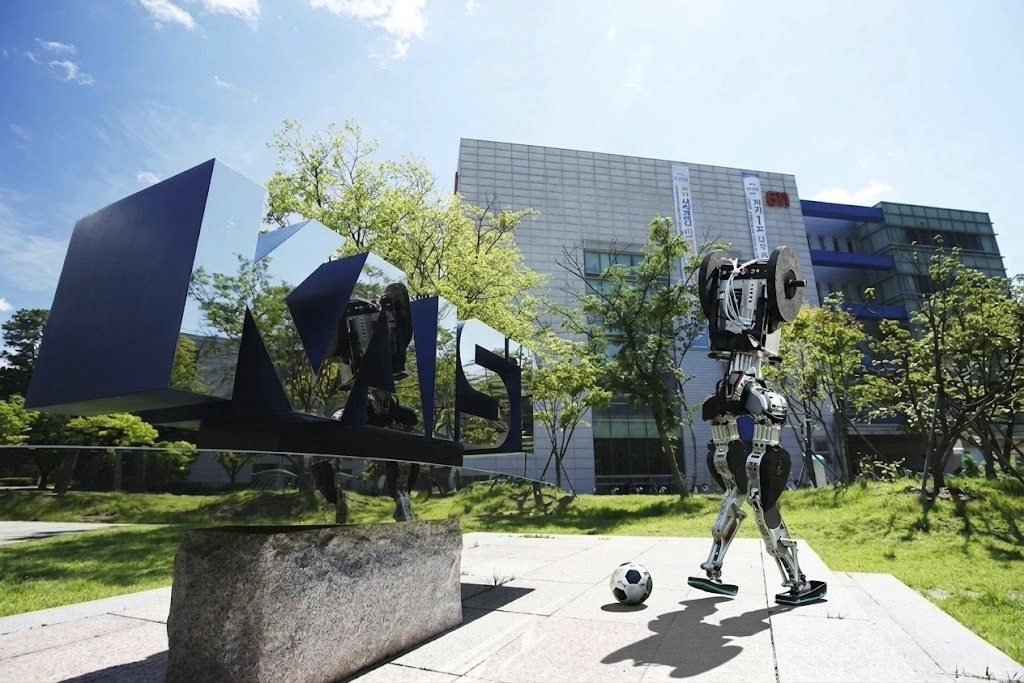
A robot that moonwalks like Michael Jackson, sprints across a soccer field at 7.3 miles per hour, and changes direction mid-stride without losing its footing — South Korea’s KAIST just made the rest of the world’s humanoid robotics labs pay close attention. The university’s latest creation, the Humanoid v0.7, is making headlines this week for a stunning real-world field test that showcases what “Physical AI” can actually look like when it leaves the lab.
Built From the Ground Up — Literally
What makes the KAIST Humanoid v0.7 stand out isn’t just what it can do — it’s how it was built. The entire robot was developed in-house by the Dynamic Robot Control & Design Laboratory (DRCD Lab) under the leadership of Professor Hae-Won Park. That means the motors, gearboxes, and motor drivers were all custom-engineered at KAIST, making the platform almost entirely technically independent from commercial suppliers.
At 165 pounds (75 kg) and standing five-foot-five, the v0.7 is roughly human-sized. But its Quasi-Direct Drive (QDD) architecture — borrowed from the school’s earlier work on legged robots — gives it a key advantage: high torque, low latency, and remarkably smooth force control. That’s the hardware backbone behind every fluid movement you see in the field test.
The Field Test That Went Viral
Footage released this week shows the KAIST v0.7 doing things that would have seemed like science fiction just a few years ago. In the outdoor field test, the robot:
- Sprints across a grass soccer field at speeds up to 7.3 mph (12 km/h)
- Kicks a ball toward the goal with accurate follow-through
- Changes running direction without slowing to a stop
- Performs a smooth, fluid moonwalk — gliding backward in a way that closely resembles the iconic Michael Jackson move
- Climbs steps over 12 inches (30 cm) high
The moonwalk, in particular, has attracted enormous attention online. It isn’t a gimmick. According to the DRCD Lab, it’s a demonstration of whole-body balance and fine motor coordination — exactly the kind of capability that separates current-generation Physical AI robots from their predecessors.
The Secret: Physical AI and Motion Capture Priors
Behind the smooth demonstrations is a sophisticated training pipeline built on deep reinforcement learning (DRL). The team trains the robot’s locomotion and manipulation policies entirely in simulation, then transfers them to hardware — a technique known as “sim-to-real” transfer. The magic ingredient that prevents the robot from moving like a stiff, jerky machine is the use of human motion capture data as a behavioral prior.
In practice, this means the robot’s movements are shaped by recordings of actual human motion. Rather than learning locomotion purely from reward signals, the robot learns to mimic the natural dynamics of human walking, running, and kicking. The result is the fluid, almost organic movement quality visible in the field test — a quality that most DRL-trained robots still struggle to achieve.
This approach is central to what the KAIST team calls Physical AI: giving autonomous machines the ability to perceive, interpret, and act on real-world environments without requiring hand-engineered motion primitives. It’s a philosophy that aligns closely with where industry heavyweights like Boston Dynamics, Figure AI, and NVIDIA’s Isaac platform are all heading.
What Comes Next for v0.7
The current v0.7 platform is already impressive, but the DRCD Lab isn’t stopping here. The team has outlined aggressive near-term targets: pushing top running speed to 14 km/h (about 8.7 mph), adding ladder-climbing capability, and achieving step-climbing over 40 cm — more than double the current spec.
Perhaps most interesting is the lab’s work on a system called DynaFlow, which aims to let the robot learn tasks directly from human demonstrations. The concept is straightforward but powerful: a worker performs a task once, and the robot watches and learns to replicate it. If DynaFlow works at scale, it could dramatically reduce the data and programming overhead required to deploy humanoid robots in new environments.
Why This Matters for the Industry
The KAIST Humanoid v0.7 is significant for reasons beyond its impressive party tricks. It represents a national research lab achieving competitive performance with hardware developed entirely in-house — no Boston Dynamics actuators, no off-the-shelf servo ecosystem. South Korea is making a clear statement that it intends to be a top-tier player in the global humanoid race alongside the United States and China.
More broadly, the v0.7 field test is a data point in a rapidly accelerating trend: Physical AI systems that can operate gracefully in unstructured real-world environments are no longer the exclusive domain of well-funded commercial startups. University labs, with the right talent and the right training infrastructure, are closing the gap fast.
At InteliDroid, we’ll be watching closely as KAIST pushes toward its next performance milestones — and as the rest of the field races to answer back.



Robotic
UBTech’s UWORLD U1 Companion Humanoid Begins Shipping to Chinese Homes
UBTech begins delivering its UWORLD U1 on September 16 — a China-only, companionship-focused humanoid priced from roughly $16,500 to $137,000, with more than 13,000 preorders already booked.
On September 16, one of the year’s most closely watched consumer robots stops being a preorder and becomes a product you can actually take home. That is the day UBTech begins mass production and delivery of the UWORLD U1, the full-size humanoid it is pitching not as a household worker but as a companion. After more than 13,000 reservations, the U1 is about to test whether ordinary buyers are ready to live alongside a two-legged robot.
A companion, not a chore-bot
UBTech has been unusually blunt about what the U1 is not. Speaking at the launch, founder and CEO Zhou Jian told the audience the robot is built for emotional companionship, not labor: it does not clean, it does not cook, and it is sold only to adults. Interaction data is stored locally on the device, with no mandatory upload to the cloud, a deliberate answer to the privacy anxieties that shadow any always-listening machine in the home.
That positioning sets the U1 apart from most of the humanoids making headlines this year, which chase warehouse, factory, and logistics work. Instead of competing on how many packages it can sort, the U1 competes on presence, conversation, and the novelty of a life-sized robot that reacts to the people around it.
Three robots, three very different price tags
UWORLD, UBTech’s new consumer brand, is launching the U1 in three tiers so the concept can reach both curious early adopters and deep-pocketed collectors:
- U1 Lite — a half-body model at 119,800 yuan (roughly $16,500), the entry point into the lineup.
- U1 Pro — a full-body version at 169,800 yuan (about $23,500).
- U1 Ultra — the high-dynamic flagship, offered in two variants priced at 880,000 and 990,000 yuan (roughly $122,000 to $137,000).
The spread is enormous, but it reflects a bet that “companion humanoid” can be a category with a mass-market floor and a luxury ceiling, much like the early car or smartphone markets before them.
13,000 orders and a China-only rollout
Demand has already outpaced expectations. Presales opened on JD.com in early June and cleared 1,000 reservations within three days; by the June launch event, cross-channel orders had reached 13,361 units. UBTech is targeting more than 10,000 deliveries for the full year and has promised every preorder holder a unit by December 31, 2026.
For now, the rollout is limited to mainland China. That keeps the U1 out of reach for buyers in the U.S. and Europe, but it also concentrates a remarkable amount of real-world deployment in a single market, exactly the kind of scale that turns a flashy demo into a maturing product line.
Why the U1 matters for the wider industry
The timing is telling. Humanoid shipments surged roughly 272% year over year in the first half of 2026 to an estimated 19,000 to 22,000 units, with Chinese manufacturers accounting for the overwhelming majority. The U1 is both a symptom and a driver of that curve: it moves humanoids out of controlled industrial pilots and into living rooms, where reliability, safety, and everyday usefulness are judged by non-experts.
Whether buyers keep their U1 switched on a year from now is the real experiment. If UBTech can turn 13,000 preorders into 13,000 satisfied households, it will have proven something the entire sector has only promised so far — that a humanoid robot can earn a permanent place in an ordinary home. At InteliDroid, we will be watching September 16 closely, because the first wave of deliveries is where the companion-robot era stops being a pitch and starts being a track record.
Robotic
Robots Take the Oval: Inside Beijing’s 2026 World Humanoid Robot Games
The second World Humanoid Robot Games has drawn more than 2,000 machines from 16 countries to Beijing — and one just clocked a 100-meter time faster than Usain Bolt. Here’s what the spectacle reveals about how far humanoids have really come.
For four days at Beijing’s National Speed Skating Oval, the athletes wobbling toward the finish line aren’t human. The second edition of the World Humanoid Robot Games opened on August 22, 2026, turning the venue that hosted Olympic speed skating into a proving ground for bipedal machines — and the headline moment arrived almost immediately, when a robot ran 100 meters faster than any person ever has.
A Bigger, Faster Second Edition
If the inaugural 2025 games were a curiosity, this year’s event is a statement of scale. Organizers report 666 competing teams fielding 2,056 humanoid robots from 16 countries — a 138% jump in teams and a roughly fourfold increase in robots compared with the first edition. The competition runs August 22 to 26 and spans 26 events, blending head-to-head contests, exhibition showcases, and “scenario” challenges designed to test robots on tasks closer to real-world work than to sport.
The event is jointly organized by the Beijing municipal government and China Media Group, among others, and its stated goal is less about medals than about momentum: accelerating the integration of humanoids into everyday human environments.
The 9.39-Second Sprint That Stole the Show
The moment that rocketed around the world came on the track. Tiangong Ultra, built by the Beijing Humanoid Robot Innovation Center, won its 100-meter heat in 9.39 seconds — quicker than Usain Bolt’s human world record of 9.58 seconds. A separate machine, Honor’s “Lightning,” was reported to have gone even faster, 9.32 seconds, in a preparatory test run.
It’s a genuinely striking milestone for legged locomotion, but it deserves context. These are controlled demonstrations by purpose-built sprinters, not a like-for-like challenge to human athletics — the robots run their own heats under their own conditions. What the time really signals is how quickly balance, actuation, and control systems have matured. A machine keeping itself upright at that velocity is solving a hard dynamics problem in real time, and doing it repeatably enough to race.
Beyond the Track: Tug-of-War, Weightlifting, and Taijiquan
Speed grabs the headlines, but the more telling events are the new ones. This year’s program adds tug-of-war and weightlifting — tests of force, grip, and stability under load — alongside debut demonstrations rooted in Chinese tradition, including Taijiquan (tai chi) and Touhu, an ancient arrow-throwing game. Football returns as well, pushing robots to perceive, plan, and coordinate as a team.
Taken together, the roster reads like a checklist of the capabilities humanoids need on a factory floor or in a warehouse:
- Explosive, stable locomotion — the sprints and jumps.
- Whole-body force control — tug-of-war and weightlifting.
- Fine balance and smooth motion — the deliberate, flowing forms of tai chi.
- Perception and precision — aiming in Touhu, tracking a ball in football.
Spectacle vs. Substance
The games are a showcase, and it’s worth separating the highlight reel from the day-to-day reality. Industry leaders have been candid that humanoids remain less efficient than people at most tasks and still take considerable time to learn new skills — a bottleneck that no stadium record erases. A robot that beats Bolt over 100 meters may still struggle to reliably fold a shirt or navigate a cluttered stockroom.
That tension — dazzling peak performance alongside stubborn practical limits — is exactly what makes the 2026 games useful to watch. Events like the scenario challenges are where the field’s real progress will show, because they reward robots that can generalize rather than specialize.
What It Signals
Beijing’s ballooning entry list is the clearest sign yet that humanoid robotics has moved from a handful of flagship labs to a broad, competitive ecosystem spanning startups, tech giants, and national research centers. The sprint records will age quickly; the more durable story is the sheer density of teams now iterating on the same hard problems in public. At InteliDroid we’ll be tracking which of these competitors turn stadium spectacle into shipping product — because the machines that matter won’t be the fastest on the oval, but the most useful off it.
Humanoid Robots
Unitree Goes Public: China’s First Listed Humanoid Robot Maker Prices Its IPO at a $9 Billion Valuation
Hangzhou’s Unitree Robotics priced its Shanghai STAR Market IPO at a roughly $9 billion valuation — becoming China’s first publicly traded humanoid robot maker, with AI lab DeepSeek joining as a strategic investor and co-development partner.
China just minted its first publicly traded humanoid robot company. On August 6, Hangzhou-based Unitree Robotics priced its Shanghai STAR Market IPO at 150.80 yuan per share, stamping the nine-year-old startup with a valuation of roughly $9 billion and kicking off one of the most closely watched listings of the embodied-AI era. Subscriptions open today, August 10, with the shares expected to begin trading between August 17 and 21.
For an industry that has run largely on venture capital, glossy demo videos, and promises about the future of physical labor, Unitree’s debut is a milestone of a different kind: a humanoid maker being priced by public markets, in real time, on its actual numbers.
A landmark listing for a nascent industry
Unitree is selling 40.45 million new shares — about 10% of its enlarged share capital — to raise roughly 6.1 billion yuan (around $850 million). The final price of 150.80 yuan came in about 45% above the market consensus of 104 yuan, a sign of just how much appetite there is for exposure to humanoid robotics. Investment banks expect a further re-rating once trading begins, with estimates ranging from 40 billion yuan to as high as 109 billion yuan in CCB International’s most optimistic scenario.
The company was founded in 2016 by engineer Wang Xingxing, who built Unitree around quadruped robots before pivoting hard into humanoids. Becoming China’s first listed humanoid robot maker gives Unitree not just a war chest but a public benchmark that rivals — foreign and domestic — will now be measured against.
The DeepSeek alliance: a brain for the body
The listing came with a headline-grabbing strategic partner. AI lab DeepSeek invested 140.8 million yuan (about $20.8 million) through a strategic placement, acquiring 933,399 shares — roughly 2.31% of the offering — under a 36-month lock-up. More important than the check is the accompanying co-development agreement: the two Hangzhou companies will jointly build AI models and embodied-intelligence systems for humanoid robots.
That pairing targets the central bottleneck in the field. Hardware has advanced faster than the software needed to run it, and the hardest problem in humanoid robotics remains the “brain” — a system that can interpret unfamiliar surroundings and translate a plain-language instruction into precise, safe physical action. Marrying DeepSeek’s large-language-model expertise to Unitree’s motion control and mechanical engineering is a bet that China can close that gap with domestic technology on both sides.
Why investors are betting on Unitree
Unlike many humanoid startups, Unitree is already shipping in volume — and making money. According to its prospectus, the company delivered more than 5,500 humanoids in 2025, with annual revenue quadrupling to 1.7 billion yuan and gross margins around 60%. That profitability stands in sharp contrast to some Western peers carrying enormous valuations on comparatively thin revenue.
The strategy is a full product ladder built around price. Unitree’s offerings include:
- Go2 — its agile robot dog, starting around $1,600
- G1 — a developer- and research-focused humanoid at roughly $13,500, widely cited as the cheapest genuinely capable humanoid on the market
- H1 — a full-size humanoid listed near $90,000
- H2 — its newest full-size platform priced around $29,900
By undercutting competitors on hardware and seeding developers with affordable machines, Unitree has positioned itself as the low-cost backbone of an emerging ecosystem — the company others build on top of.
What it signals for the humanoid race
A profitable, publicly listed humanoid champion — paired with a homegrown AI lab — reshapes the competitive map. It hands Unitree fresh capital and a currency for acquisitions and talent, and it gives investors a liquid way to bet on embodied AI for the first time. It also arrives amid tightening scrutiny of where connected robots are built and where their data flows, a backdrop that will shape how far Chinese humanoids travel into Western markets.
For now, the takeaway is simple: the humanoid robotics story is moving from pitch decks to public balance sheets. As the sector matures from demos into deployed, revenue-generating machines, Unitree’s listing may be remembered as the moment the market started pricing the robots that will share our factories, warehouses, and eventually our homes. At InteliDroid, we’ll be watching where the capital — and the machines — go next.

UBTech’s UWORLD U1 Companion Humanoid Begins Shipping to Chinese Homes

Robots Take the Oval: Inside Beijing’s 2026 World Humanoid Robot Games

Unitree Goes Public: China’s First Listed Humanoid Robot Maker Prices Its IPO at a $9 Billion Valuation

BYD Joins the Humanoid Race: Meet “Xiao Di,” the Robot Headed for Its Showrooms

URKL Debuts in Shenzhen: The World’s First Autonomous Humanoid Combat League

Germany’s NEURA Robotics Lands $1.4 Billion From Amazon, Nvidia, and Tether — The Largest Humanoid Funding Round Ever

NVIDIA Picks Unitree H2 Plus as Its First Research Humanoid Robot Platform

Gatsby Sends a Humanoid Robot Into an American Home — History Made at $150

The Imperative of Inclusion and Diversity in AI Humanoids: Cultivating Culturally Resonant Interactions

Humanoid Robots Steal the Spotlight at UN Artificial Intelligence Meeting

The Dawn of Intelligent Machines: Unveiling the Figure 01 Humanoid Robot

Agility Robotics’ Digit Achieves Commercial Breakthrough: First Revenue-Generating Bipedal Humanoid in Warehouses

Sanctuary AI’s Humanoid Robot: Blurring the Lines between Humans and Machines

Principles of Freedom in the InteliDroid AI System: A Comprehensive Exploration

Key Principles and Ethical Considerations of Law as Incorporated into the InteliDroid AI Platform: A Question and Answer Guide

Figure AI Ramps Figure 03 Production to One Per Hour: Humanoid Manufacturing Milestone
-
 Humanoid Robots1 month ago
Unitree Goes Public: China’s First Listed Humanoid Robot Maker Prices Its IPO at a $9 Billion Valuation
-
 Humanoid Robots2 months ago
URKL Debuts in Shenzhen: The World’s First Autonomous Humanoid Combat League
-
 Robotic2 months ago
BYD Joins the Humanoid Race: Meet “Xiao Di,” the Robot Headed for Its Showrooms
-
 Robotic4 weeks ago
Robots Take the Oval: Inside Beijing’s 2026 World Humanoid Robot Games
-
 Robotic4 days ago
UBTech’s UWORLD U1 Companion Humanoid Begins Shipping to Chinese Homes