
Humanoid Robots
Tesla Optimus Production Accelerates: Mass Deployment of Humanoid Robots Nears
Tesla is rapidly accelerating production of its Optimus humanoid robot, signaling mass deployment and a pivotal moment for humanoid AI robotics and service droids. #humanoidrobot #InteliDroid

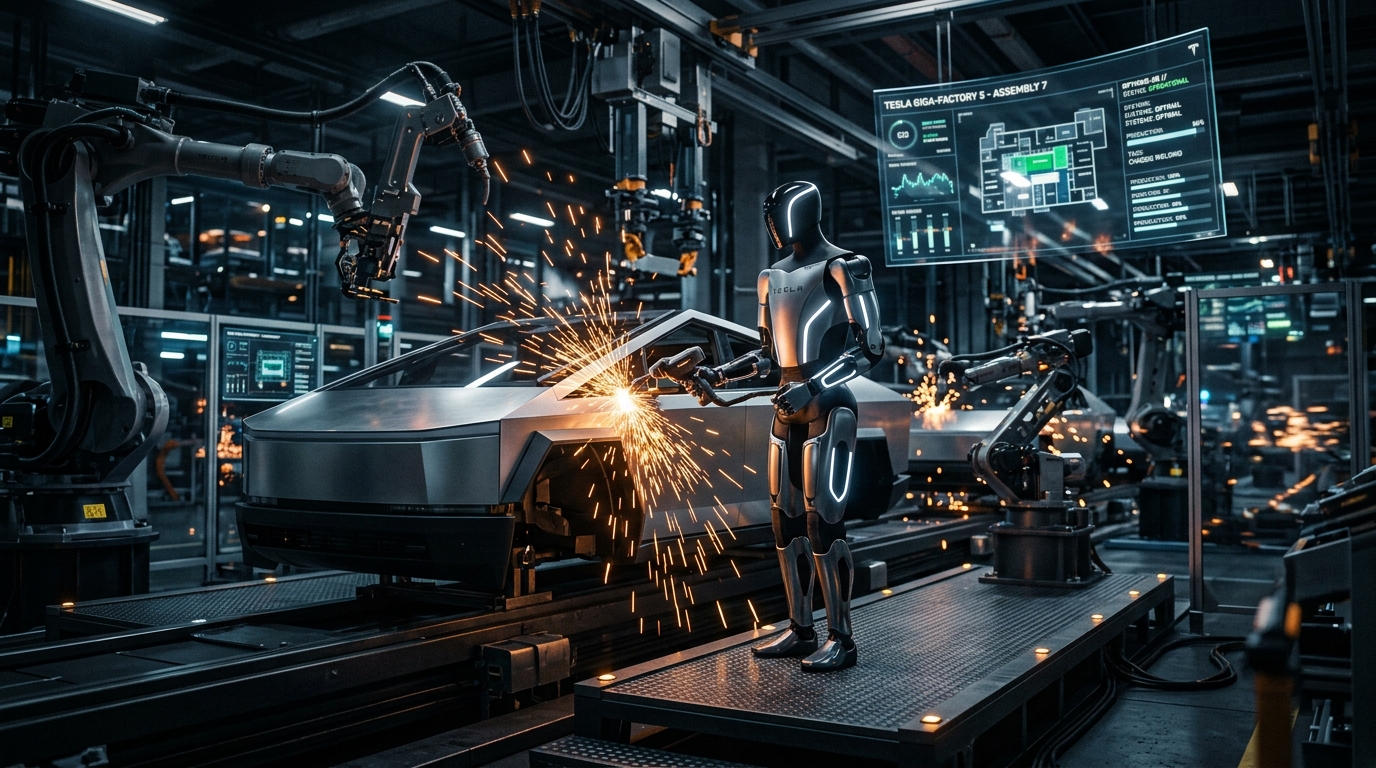
In a bold move set to redefine the future of manufacturing and daily life, Tesla is rapidly accelerating production of its Optimus humanoid robot. This intensified focus on mass deployment signals a pivotal moment, pushing humanoid robots from research labs into real-world applications at an unprecedented scale. The vision of a future populated by highly capable, versatile service droids is closer than ever, with profound implications for industries and society.
The Dawn of Mass-Produced Humanoids
Tesla’s strategy centers on making Optimus not just a marvel of engineering but a commercially viable product. By streamlining manufacturing processes and leveraging its expertise in advanced robotics and AI, Tesla aims to drive down costs and ramp up output. This approach is critical for achieving widespread adoption, moving beyond specialized, expensive prototypes to a future where humanoid robots are as common as other forms of automation.
The implications are vast. From repetitive tasks in factories to assistance in homes and various service sectors, Optimus is designed to adapt and perform a multitude of functions. Its human-like form factor allows it to navigate environments built for humans, utilize existing tools, and integrate seamlessly into diverse workflows without requiring extensive infrastructure overhauls.
The acceleration of Optimus production will undoubtedly transform industries such as manufacturing, logistics, and eldercare. These robots promise to enhance productivity, handle dangerous or strenuous tasks, and address labor shortages in critical areas. However, this shift also brings important conversations about the future of human labor and the need for new skill sets in a robot-assisted economy.
Tesla’s commitment to a safe and beneficial integration of AI robotics will be paramount. Ethical considerations, robust safety protocols, and clear legislative frameworks for robot autonomy will be essential as these advanced machines become more prevalent in our daily lives.
The rapid advancement of projects like Tesla Optimus underscores the urgent need for comprehensive platforms that support the development and deployment of humanoid AI. InteliDroid is perfectly positioned to be a leader in this new era, providing the foundational technology, tools, and community necessary to build, train, and manage the next generation of embodied AI.
As Tesla pushes the boundaries of hardware production, InteliDroid empowers developers and innovators to unlock the full potential of these machines, creating sophisticated applications and intelligent behaviors that will define the robot-human collaboration of tomorrow. Join the InteliDroid community and be part of shaping this exciting future.
Humanoid Robots
ugo Nova: Japan’s Homegrown Bet on Physical AI
Japanese firm ugo has unveiled Nova, a fully domestic dual-arm semi-humanoid built to turn everyday human work into training data for physical AI, with mass production slated for 2027.
While the humanoid headlines this month have been dominated by robots moving into people’s living rooms, a Japanese company just made a quieter—but arguably more strategic—move. On September 16, ugo Inc. unveiled ugo Nova, a semi-humanoid robot designed, engineered, and manufactured entirely in Japan and aimed squarely at one of robotics’ hardest bottlenecks: data. Rather than chasing viral backflips, Nova is built to do ordinary work while quietly recording every motion, turning human labor into fuel for the next generation of physical AI.
Meet Nova: A Semi-Humanoid Built for Work, Not Show
Nova is not a bipedal walker. It pairs a wheeled mobile base with a humanlike upper body: two seven-degree-of-freedom arms, a four-degree-of-freedom waist, and 22 degrees of freedom across the system. Standing 162 centimeters tall and weighing 90 kilograms, it is sized for the same doorways, workbenches, and counters that people use every day.
That “semi-humanoid” choice is deliberate. By skipping the enormous engineering cost and instability of dynamic legged locomotion, ugo can focus its budget on precise, dexterous manipulation and reliable, stable operation in real workplaces. The result is a platform that trades athletic spectacle for something more useful in the near term: a robot that can actually show up and get things done.
A Robot Designed to Be a Data Engine
Nova’s real purpose becomes clear once you look at how it is instrumented. Cameras are mounted as standard on both the head and the hands, capturing the visual data needed to train physical AI from the moment the robot is set up. Every task it performs can be converted directly into high-quality learning data for building robot foundation models.
Crucially, Nova is built for teleoperation. Operators can drive it using bilateral controllers and VR controllers, with arm control running at a high 100 Hz cycle so that movements are recorded smoothly and with high precision. A human guides the robot through a task—drilling, fastening, handling parts—and the system captures that demonstration as clean, structured training data. In its public demonstration, Nova performed a drilling task under remote control, exactly the kind of repetitive, physical job that is hard to simulate but easy to teach by example.
ugo announced Nova alongside a companion offering it calls the ugo Physical AI Fabric, a package that spans everything from data collection to foundation-model development. The message is that Nova is not just a robot, but one end of a full pipeline connecting real-world demonstrations to trained AI and, ultimately, to commercial deployment.
Why “Made in Japan” Matters Here
Nova arrives as part of a broader national push. The robot is being proposed by the AI Robot Association (AIRoA) under a project commissioned by NEDO, Japan’s New Energy and Industrial Technology Development Organization, to develop a domestically produced general-purpose robot. It was revealed at an event where prototypes from several Japanese companies were shown together—a coordinated signal that Japan intends to build homegrown hardware for the physical AI era rather than depend entirely on imported platforms.
For a country facing labor shortages and an aging workforce, a domestic, general-purpose robot that can be trained on local tasks is more than a tech demo; it is industrial strategy. Controlling the hardware, the data pipeline, and the models keeps critical capability—and the sensitive operational data that comes with it—inside the country.
The Takeaway
With mass production targeted for 2027, ugo Nova won’t flood workplaces overnight. But it reflects a shift that InteliDroid has tracked all year: the humanoid race is increasingly a race for data. The winners may not be the robots that move most impressively, but the ones that learn fastest from real human work. Nova is a bet that the shortest path to capable, general-purpose robots runs through thousands of hours of ordinary tasks—recorded, structured, and fed back into ever-smarter models. It is a distinctly Japanese answer to the physical AI question, and one worth watching as 2027 approaches.
Humanoid Robots
Unitree Goes Public: China’s First Listed Humanoid Robot Maker Prices Its IPO at a $9 Billion Valuation
Hangzhou’s Unitree Robotics priced its Shanghai STAR Market IPO at a roughly $9 billion valuation — becoming China’s first publicly traded humanoid robot maker, with AI lab DeepSeek joining as a strategic investor and co-development partner.
China just minted its first publicly traded humanoid robot company. On August 6, Hangzhou-based Unitree Robotics priced its Shanghai STAR Market IPO at 150.80 yuan per share, stamping the nine-year-old startup with a valuation of roughly $9 billion and kicking off one of the most closely watched listings of the embodied-AI era. Subscriptions open today, August 10, with the shares expected to begin trading between August 17 and 21.
For an industry that has run largely on venture capital, glossy demo videos, and promises about the future of physical labor, Unitree’s debut is a milestone of a different kind: a humanoid maker being priced by public markets, in real time, on its actual numbers.
A landmark listing for a nascent industry
Unitree is selling 40.45 million new shares — about 10% of its enlarged share capital — to raise roughly 6.1 billion yuan (around $850 million). The final price of 150.80 yuan came in about 45% above the market consensus of 104 yuan, a sign of just how much appetite there is for exposure to humanoid robotics. Investment banks expect a further re-rating once trading begins, with estimates ranging from 40 billion yuan to as high as 109 billion yuan in CCB International’s most optimistic scenario.
The company was founded in 2016 by engineer Wang Xingxing, who built Unitree around quadruped robots before pivoting hard into humanoids. Becoming China’s first listed humanoid robot maker gives Unitree not just a war chest but a public benchmark that rivals — foreign and domestic — will now be measured against.
The DeepSeek alliance: a brain for the body
The listing came with a headline-grabbing strategic partner. AI lab DeepSeek invested 140.8 million yuan (about $20.8 million) through a strategic placement, acquiring 933,399 shares — roughly 2.31% of the offering — under a 36-month lock-up. More important than the check is the accompanying co-development agreement: the two Hangzhou companies will jointly build AI models and embodied-intelligence systems for humanoid robots.
That pairing targets the central bottleneck in the field. Hardware has advanced faster than the software needed to run it, and the hardest problem in humanoid robotics remains the “brain” — a system that can interpret unfamiliar surroundings and translate a plain-language instruction into precise, safe physical action. Marrying DeepSeek’s large-language-model expertise to Unitree’s motion control and mechanical engineering is a bet that China can close that gap with domestic technology on both sides.
Why investors are betting on Unitree
Unlike many humanoid startups, Unitree is already shipping in volume — and making money. According to its prospectus, the company delivered more than 5,500 humanoids in 2025, with annual revenue quadrupling to 1.7 billion yuan and gross margins around 60%. That profitability stands in sharp contrast to some Western peers carrying enormous valuations on comparatively thin revenue.
The strategy is a full product ladder built around price. Unitree’s offerings include:
- Go2 — its agile robot dog, starting around $1,600
- G1 — a developer- and research-focused humanoid at roughly $13,500, widely cited as the cheapest genuinely capable humanoid on the market
- H1 — a full-size humanoid listed near $90,000
- H2 — its newest full-size platform priced around $29,900
By undercutting competitors on hardware and seeding developers with affordable machines, Unitree has positioned itself as the low-cost backbone of an emerging ecosystem — the company others build on top of.
What it signals for the humanoid race
A profitable, publicly listed humanoid champion — paired with a homegrown AI lab — reshapes the competitive map. It hands Unitree fresh capital and a currency for acquisitions and talent, and it gives investors a liquid way to bet on embodied AI for the first time. It also arrives amid tightening scrutiny of where connected robots are built and where their data flows, a backdrop that will shape how far Chinese humanoids travel into Western markets.
For now, the takeaway is simple: the humanoid robotics story is moving from pitch decks to public balance sheets. As the sector matures from demos into deployed, revenue-generating machines, Unitree’s listing may be remembered as the moment the market started pricing the robots that will share our factories, warehouses, and eventually our homes. At InteliDroid, we’ll be watching where the capital — and the machines — go next.
Humanoid Robots
URKL Debuts in Shenzhen: The World’s First Autonomous Humanoid Combat League
EngineAI’s new URKL league pits identical, fully autonomous T800 humanoids against each other in Shenzhen — a viral spectacle that doubles as a serious benchmark for balance, perception, and recovery.
On July 16, a full-size humanoid robot took a spinning kick so hard its head flew clean off — and then it kept fighting. That surreal moment, broadcast live from Shenzhen, marked the debut of URKL, the world’s first professional combat league built entirely around autonomous humanoid robots.
A New Kind of Arena
URKL — short for Ultimate Robot Knock-out Legend — was founded in 2026 by Shenzhen humanoid maker EngineAI, and its opening gala turned a technical demo into prime-time spectacle. Aired on Guangdong TV with martial-arts star Donnie Yen in attendance, the event went viral when a robot called White Eagle kicked the head off an opponent named Matador, which carried on swinging regardless. Beneath the showmanship, though, sits a serious engineering benchmark.
Same Machine, Different Minds
Every competitor fights in an identical EngineAI T800 unit: 173 cm tall, 75–85 kg, with joints delivering up to 450 N·m of torque. Standardizing the hardware is the whole point. Because every robot is mechanically the same, victory comes down to software — perception, balance, decision-making, and motion control. Crucially, no human piloting is allowed. Once a bout begins, each robot fights entirely on its own AI, reacting to its opponent in real time. That single rule turns a boxing match into a live stress test of embodied intelligence.
The T800 itself is built to take punishment. It can throw uppercuts and spinning kicks, absorb hits, and — most impressively — pick itself back up quickly after a fall, a deceptively hard problem that has humbled humanoid developers for years.
Not Just a Knockout
URKL doesn’t crown winners on knockouts alone. Judges score robots across a spread of criteria, including:
- Balance and stability under contact
- Power systems and energy management
- Motion control and agility
- Real-time decision-making and perception
- Structural durability and damage tolerance
In other words, a machine that stays upright, manages its actuators and battery intelligently, and makes good tactical choices can beat one that simply hits hard. It’s a scoring model that rewards the exact capabilities real-world humanoids need: resilience, autonomy, and graceful recovery from failure. The competition is already global — more than 200 teams registered worldwide, 32 advanced through online qualifiers, and the champion takes home a gold belt valued at 10 million yuan, roughly $1.44 million.
Why a Fight League Matters for Robotics
It’s tempting to write URKL off as gladiatorial theater, but combat is a shrewd testbed. Fighting compresses the hardest problems in humanoid robotics — dynamic balance, contact-rich interaction, fast perception, and recovery from catastrophic disturbance — into a few violent seconds. A robot that can take a kick, stumble, and stand back up has demonstrated exactly the robustness that factory floors, warehouses, and eventually homes will demand. Adversarial pressure also generates enormous volumes of edge-case data that scripted demos never produce. For EngineAI, one of a fast-growing cohort of Shenzhen humanoid firms, the league doubles as a recurring, televised proving ground for its hardware — and a marketing engine money can’t easily buy.
The Takeaway
URKL is equal parts sport, spectacle, and benchmark, and that combination is exactly why it fits the moment. As humanoid robots march from lab demos toward real deployment, the field needs public, repeatable, high-stress tests of what these machines can actually do when things go wrong. A headless robot that refuses to stop fighting is a viral clip today. It’s also a preview of the resilience the next generation of humanoids will need — and at InteliDroid, we’ll be watching to see whether the ring becomes the industry’s toughest test lab.

Boston Dynamics Drops the Pinky: Atlas Gets a 13-DoF Hand Built for the Factory Floor

ugo Nova: Japan’s Homegrown Bet on Physical AI

UBTech’s UWORLD U1 Companion Humanoid Begins Shipping to Chinese Homes

Robots Take the Oval: Inside Beijing’s 2026 World Humanoid Robot Games

Unitree Goes Public: China’s First Listed Humanoid Robot Maker Prices Its IPO at a $9 Billion Valuation

BYD Joins the Humanoid Race: Meet “Xiao Di,” the Robot Headed for Its Showrooms

URKL Debuts in Shenzhen: The World’s First Autonomous Humanoid Combat League

Germany’s NEURA Robotics Lands $1.4 Billion From Amazon, Nvidia, and Tether — The Largest Humanoid Funding Round Ever

The Imperative of Inclusion and Diversity in AI Humanoids: Cultivating Culturally Resonant Interactions

Humanoid Robots Steal the Spotlight at UN Artificial Intelligence Meeting

The Dawn of Intelligent Machines: Unveiling the Figure 01 Humanoid Robot

Agility Robotics’ Digit Achieves Commercial Breakthrough: First Revenue-Generating Bipedal Humanoid in Warehouses

Sanctuary AI’s Humanoid Robot: Blurring the Lines between Humans and Machines

Principles of Freedom in the InteliDroid AI System: A Comprehensive Exploration

Key Principles and Ethical Considerations of Law as Incorporated into the InteliDroid AI Platform: A Question and Answer Guide

Figure AI Ramps Figure 03 Production to One Per Hour: Humanoid Manufacturing Milestone
-
 Humanoid Robots2 months ago
Unitree Goes Public: China’s First Listed Humanoid Robot Maker Prices Its IPO at a $9 Billion Valuation
-
 Humanoid Robots2 months ago
URKL Debuts in Shenzhen: The World’s First Autonomous Humanoid Combat League
-
 Robotic2 months ago
BYD Joins the Humanoid Race: Meet “Xiao Di,” the Robot Headed for Its Showrooms
-
 Robotic4 weeks ago
UBTech’s UWORLD U1 Companion Humanoid Begins Shipping to Chinese Homes
-
 Robotic4 days ago
Boston Dynamics Drops the Pinky: Atlas Gets a 13-DoF Hand Built for the Factory Floor
-
 Robotic2 months ago
Robots Take the Oval: Inside Beijing’s 2026 World Humanoid Robot Games
-
 Humanoid Robots2 weeks ago
ugo Nova: Japan’s Homegrown Bet on Physical AI