
Robotic
Agibot Hits 10,000 Humanoid Robots: The Production Milestone That Changes Everything
Chinese robotics firm Agibot has shipped its 10,000th humanoid robot, doubling production in just three months and signaling a new era of mass deployment.

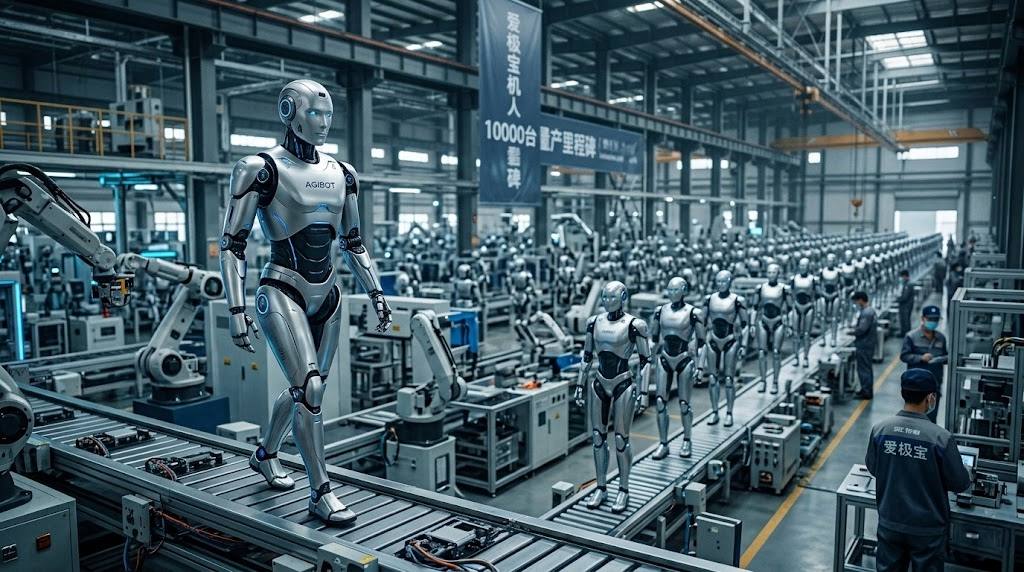
On March 30, 2026, Shanghai-based Agibot rolled its 10,000th humanoid robot off the production line — becoming one of the first companies in the industry to reach this threshold at genuine commercial scale. What makes this number remarkable isn’t just its size; it’s the speed. Agibot went from 5,000 to 10,000 units in only three months, a pace more than four times faster than its previous production phase. That kind of acceleration, in an industry that has spent years promising mass deployment, is worth paying close attention to.
From Prototype Dreams to Production Reality
Agibot was founded in February 2023 by former Huawei engineers Deng Taihua (CEO) and Peng Zhihui (CTO) — the latter having built a cult following in China for personal robotics projects, including a self-driving bicycle and an Iron Man-style robotic arm. The company moved fast: it secured six funding rounds from major backers including HongShan (Sequoia China), Baidu, and SAIC Motor, reaching a valuation north of $960 million USD before its third birthday.
The production numbers are telling. It took Agibot nearly two years to hit its first 1,000 units, about a year to scale to 5,000, and just three months to double that to 10,000. According to analyst firm Omdia, Agibot shipped 5,168 humanoid robots in 2025 alone — more than any other company globally, in a market that collectively shipped roughly 13,000 units industry-wide that year. That means Agibot commanded roughly 40% of global humanoid robot shipments in 2025.
Where the Robots Are Going
These aren’t warehouse curiosities sitting in labs. Agibot’s robots are deployed across logistics, retail showrooms, hospitality services, education, and increasingly, industrial manufacturing lines. Their flagship A2 bipedal humanoid stands 1.75 meters tall and is capable of tasks as precise as threading a needle. The industrial-grade G2 wheeled model achieves sub-millimeter assembly precision with force control suited for automotive-grade tasks. The company’s embodied AI operating system, Lingqu OS, runs across their product family — providing a common software foundation that speeds up real-world deployment.
This isn’t a single product story. Agibot’s portfolio now spans six product lines ranging from the ~$20,000 X2 education robot to the full-size A2 priced between $100,000–$190,000. That product breadth — from classroom to factory floor — positions Agibot as something genuinely different from the narrowly focused Western competitors still figuring out their first commercial deployment.
The China Advantage — and Its Implications
Agibot’s milestone doesn’t exist in a vacuum. It’s part of a broader Chinese push to dominate humanoid robotics at scale. In late February 2026, China’s Ministry of Industry and Information Technology published its first national standard system for humanoid robots and embodied intelligence — a formal framework covering brain-like computing, limb components, full-machine systems, and safety ethics. More than 120 researchers and policymakers convened in Beijing to establish these standards, signaling that China is treating humanoid robotics as a strategic national industry, not just a startup story.
The contrast with Western competitors is sharp. Tesla’s Optimus program, despite years of headlines, is still in R&D phase with no robots confirmed doing productive work in factories as of Q1 2026. Figure AI carries a $39 billion Series C valuation that many analysts view as running ahead of commercial reality. Boston Dynamics is shipping its electric Atlas — but all 2026 units are already committed to Hyundai’s facilities and Google DeepMind. Meanwhile, Agibot has already shipped 10,000 robots across real-world paying customers.
Physical AI Investment Is Accelerating Globally
Agibot’s milestone lands at a moment of unprecedented investor conviction in physical AI. Q1 2026 saw $300 billion flow into global venture deals, with AI commanding 80% of that total. Physical Intelligence — the two-year-old San Francisco startup building foundation models for robots — is reportedly in talks to raise $1 billion at an $11 billion valuation, effectively doubling its valuation in just four months. The robotics funding boom is real, and it’s not confined to any one geography.
But there’s an important distinction between capital and output. Agibot has translated investment into actual units, actual deployments, and actual production velocity. That’s the gap that matters — and it’s the gap that the rest of the industry is racing to close.
InteliDroid Perspective
The vision at InteliDroid has always been a future where capable, versatile humanoid robots are widely owned and genuinely useful — not just enterprise curiosities locked behind million-dollar contracts. Agibot’s 10,000-unit milestone moves that vision measurably closer to reality. When production curves bend this sharply upward, prices tend to follow — downward. The X2 at $20,000 and the A2 at $100,000–$190,000 are still out of reach for most consumers, but the economics of scale are doing their work.
China reaching this production threshold first matters not just competitively, but for the whole industry. It proves that humanoid robots can be manufactured at commercial scale. What happens in Agibot’s Shanghai facility today shapes what robots cost — and who can afford them — tomorrow.
What to Watch Next
Keep an eye on whether Western humanoid robot makers respond to Agibot’s production momentum with accelerated timelines of their own — and watch for Agibot’s next pricing moves as it eyes global market expansion beyond China.
Humanoid Robots
ugo Nova: Japan’s Homegrown Bet on Physical AI
Japanese firm ugo has unveiled Nova, a fully domestic dual-arm semi-humanoid built to turn everyday human work into training data for physical AI, with mass production slated for 2027.
While the humanoid headlines this month have been dominated by robots moving into people’s living rooms, a Japanese company just made a quieter—but arguably more strategic—move. On September 16, ugo Inc. unveiled ugo Nova, a semi-humanoid robot designed, engineered, and manufactured entirely in Japan and aimed squarely at one of robotics’ hardest bottlenecks: data. Rather than chasing viral backflips, Nova is built to do ordinary work while quietly recording every motion, turning human labor into fuel for the next generation of physical AI.
Meet Nova: A Semi-Humanoid Built for Work, Not Show
Nova is not a bipedal walker. It pairs a wheeled mobile base with a humanlike upper body: two seven-degree-of-freedom arms, a four-degree-of-freedom waist, and 22 degrees of freedom across the system. Standing 162 centimeters tall and weighing 90 kilograms, it is sized for the same doorways, workbenches, and counters that people use every day.
That “semi-humanoid” choice is deliberate. By skipping the enormous engineering cost and instability of dynamic legged locomotion, ugo can focus its budget on precise, dexterous manipulation and reliable, stable operation in real workplaces. The result is a platform that trades athletic spectacle for something more useful in the near term: a robot that can actually show up and get things done.
A Robot Designed to Be a Data Engine
Nova’s real purpose becomes clear once you look at how it is instrumented. Cameras are mounted as standard on both the head and the hands, capturing the visual data needed to train physical AI from the moment the robot is set up. Every task it performs can be converted directly into high-quality learning data for building robot foundation models.
Crucially, Nova is built for teleoperation. Operators can drive it using bilateral controllers and VR controllers, with arm control running at a high 100 Hz cycle so that movements are recorded smoothly and with high precision. A human guides the robot through a task—drilling, fastening, handling parts—and the system captures that demonstration as clean, structured training data. In its public demonstration, Nova performed a drilling task under remote control, exactly the kind of repetitive, physical job that is hard to simulate but easy to teach by example.
ugo announced Nova alongside a companion offering it calls the ugo Physical AI Fabric, a package that spans everything from data collection to foundation-model development. The message is that Nova is not just a robot, but one end of a full pipeline connecting real-world demonstrations to trained AI and, ultimately, to commercial deployment.
Why “Made in Japan” Matters Here
Nova arrives as part of a broader national push. The robot is being proposed by the AI Robot Association (AIRoA) under a project commissioned by NEDO, Japan’s New Energy and Industrial Technology Development Organization, to develop a domestically produced general-purpose robot. It was revealed at an event where prototypes from several Japanese companies were shown together—a coordinated signal that Japan intends to build homegrown hardware for the physical AI era rather than depend entirely on imported platforms.
For a country facing labor shortages and an aging workforce, a domestic, general-purpose robot that can be trained on local tasks is more than a tech demo; it is industrial strategy. Controlling the hardware, the data pipeline, and the models keeps critical capability—and the sensitive operational data that comes with it—inside the country.
The Takeaway
With mass production targeted for 2027, ugo Nova won’t flood workplaces overnight. But it reflects a shift that InteliDroid has tracked all year: the humanoid race is increasingly a race for data. The winners may not be the robots that move most impressively, but the ones that learn fastest from real human work. Nova is a bet that the shortest path to capable, general-purpose robots runs through thousands of hours of ordinary tasks—recorded, structured, and fed back into ever-smarter models. It is a distinctly Japanese answer to the physical AI question, and one worth watching as 2027 approaches.
Robotic
UBTech’s UWORLD U1 Companion Humanoid Begins Shipping to Chinese Homes
UBTech begins delivering its UWORLD U1 on September 16 — a China-only, companionship-focused humanoid priced from roughly $16,500 to $137,000, with more than 13,000 preorders already booked.
On September 16, one of the year’s most closely watched consumer robots stops being a preorder and becomes a product you can actually take home. That is the day UBTech begins mass production and delivery of the UWORLD U1, the full-size humanoid it is pitching not as a household worker but as a companion. After more than 13,000 reservations, the U1 is about to test whether ordinary buyers are ready to live alongside a two-legged robot.
A companion, not a chore-bot
UBTech has been unusually blunt about what the U1 is not. Speaking at the launch, founder and CEO Zhou Jian told the audience the robot is built for emotional companionship, not labor: it does not clean, it does not cook, and it is sold only to adults. Interaction data is stored locally on the device, with no mandatory upload to the cloud, a deliberate answer to the privacy anxieties that shadow any always-listening machine in the home.
That positioning sets the U1 apart from most of the humanoids making headlines this year, which chase warehouse, factory, and logistics work. Instead of competing on how many packages it can sort, the U1 competes on presence, conversation, and the novelty of a life-sized robot that reacts to the people around it.
Three robots, three very different price tags
UWORLD, UBTech’s new consumer brand, is launching the U1 in three tiers so the concept can reach both curious early adopters and deep-pocketed collectors:
- U1 Lite — a half-body model at 119,800 yuan (roughly $16,500), the entry point into the lineup.
- U1 Pro — a full-body version at 169,800 yuan (about $23,500).
- U1 Ultra — the high-dynamic flagship, offered in two variants priced at 880,000 and 990,000 yuan (roughly $122,000 to $137,000).
The spread is enormous, but it reflects a bet that “companion humanoid” can be a category with a mass-market floor and a luxury ceiling, much like the early car or smartphone markets before them.
13,000 orders and a China-only rollout
Demand has already outpaced expectations. Presales opened on JD.com in early June and cleared 1,000 reservations within three days; by the June launch event, cross-channel orders had reached 13,361 units. UBTech is targeting more than 10,000 deliveries for the full year and has promised every preorder holder a unit by December 31, 2026.
For now, the rollout is limited to mainland China. That keeps the U1 out of reach for buyers in the U.S. and Europe, but it also concentrates a remarkable amount of real-world deployment in a single market, exactly the kind of scale that turns a flashy demo into a maturing product line.
Why the U1 matters for the wider industry
The timing is telling. Humanoid shipments surged roughly 272% year over year in the first half of 2026 to an estimated 19,000 to 22,000 units, with Chinese manufacturers accounting for the overwhelming majority. The U1 is both a symptom and a driver of that curve: it moves humanoids out of controlled industrial pilots and into living rooms, where reliability, safety, and everyday usefulness are judged by non-experts.
Whether buyers keep their U1 switched on a year from now is the real experiment. If UBTech can turn 13,000 preorders into 13,000 satisfied households, it will have proven something the entire sector has only promised so far — that a humanoid robot can earn a permanent place in an ordinary home. At InteliDroid, we will be watching September 16 closely, because the first wave of deliveries is where the companion-robot era stops being a pitch and starts being a track record.
Robotic
Robots Take the Oval: Inside Beijing’s 2026 World Humanoid Robot Games
The second World Humanoid Robot Games has drawn more than 2,000 machines from 16 countries to Beijing — and one just clocked a 100-meter time faster than Usain Bolt. Here’s what the spectacle reveals about how far humanoids have really come.
For four days at Beijing’s National Speed Skating Oval, the athletes wobbling toward the finish line aren’t human. The second edition of the World Humanoid Robot Games opened on August 22, 2026, turning the venue that hosted Olympic speed skating into a proving ground for bipedal machines — and the headline moment arrived almost immediately, when a robot ran 100 meters faster than any person ever has.
A Bigger, Faster Second Edition
If the inaugural 2025 games were a curiosity, this year’s event is a statement of scale. Organizers report 666 competing teams fielding 2,056 humanoid robots from 16 countries — a 138% jump in teams and a roughly fourfold increase in robots compared with the first edition. The competition runs August 22 to 26 and spans 26 events, blending head-to-head contests, exhibition showcases, and “scenario” challenges designed to test robots on tasks closer to real-world work than to sport.
The event is jointly organized by the Beijing municipal government and China Media Group, among others, and its stated goal is less about medals than about momentum: accelerating the integration of humanoids into everyday human environments.
The 9.39-Second Sprint That Stole the Show
The moment that rocketed around the world came on the track. Tiangong Ultra, built by the Beijing Humanoid Robot Innovation Center, won its 100-meter heat in 9.39 seconds — quicker than Usain Bolt’s human world record of 9.58 seconds. A separate machine, Honor’s “Lightning,” was reported to have gone even faster, 9.32 seconds, in a preparatory test run.
It’s a genuinely striking milestone for legged locomotion, but it deserves context. These are controlled demonstrations by purpose-built sprinters, not a like-for-like challenge to human athletics — the robots run their own heats under their own conditions. What the time really signals is how quickly balance, actuation, and control systems have matured. A machine keeping itself upright at that velocity is solving a hard dynamics problem in real time, and doing it repeatably enough to race.
Beyond the Track: Tug-of-War, Weightlifting, and Taijiquan
Speed grabs the headlines, but the more telling events are the new ones. This year’s program adds tug-of-war and weightlifting — tests of force, grip, and stability under load — alongside debut demonstrations rooted in Chinese tradition, including Taijiquan (tai chi) and Touhu, an ancient arrow-throwing game. Football returns as well, pushing robots to perceive, plan, and coordinate as a team.
Taken together, the roster reads like a checklist of the capabilities humanoids need on a factory floor or in a warehouse:
- Explosive, stable locomotion — the sprints and jumps.
- Whole-body force control — tug-of-war and weightlifting.
- Fine balance and smooth motion — the deliberate, flowing forms of tai chi.
- Perception and precision — aiming in Touhu, tracking a ball in football.
Spectacle vs. Substance
The games are a showcase, and it’s worth separating the highlight reel from the day-to-day reality. Industry leaders have been candid that humanoids remain less efficient than people at most tasks and still take considerable time to learn new skills — a bottleneck that no stadium record erases. A robot that beats Bolt over 100 meters may still struggle to reliably fold a shirt or navigate a cluttered stockroom.
That tension — dazzling peak performance alongside stubborn practical limits — is exactly what makes the 2026 games useful to watch. Events like the scenario challenges are where the field’s real progress will show, because they reward robots that can generalize rather than specialize.
What It Signals
Beijing’s ballooning entry list is the clearest sign yet that humanoid robotics has moved from a handful of flagship labs to a broad, competitive ecosystem spanning startups, tech giants, and national research centers. The sprint records will age quickly; the more durable story is the sheer density of teams now iterating on the same hard problems in public. At InteliDroid we’ll be tracking which of these competitors turn stadium spectacle into shipping product — because the machines that matter won’t be the fastest on the oval, but the most useful off it.

ugo Nova: Japan’s Homegrown Bet on Physical AI

UBTech’s UWORLD U1 Companion Humanoid Begins Shipping to Chinese Homes

Robots Take the Oval: Inside Beijing’s 2026 World Humanoid Robot Games

Unitree Goes Public: China’s First Listed Humanoid Robot Maker Prices Its IPO at a $9 Billion Valuation

BYD Joins the Humanoid Race: Meet “Xiao Di,” the Robot Headed for Its Showrooms

URKL Debuts in Shenzhen: The World’s First Autonomous Humanoid Combat League

Germany’s NEURA Robotics Lands $1.4 Billion From Amazon, Nvidia, and Tether — The Largest Humanoid Funding Round Ever

NVIDIA Picks Unitree H2 Plus as Its First Research Humanoid Robot Platform

The Imperative of Inclusion and Diversity in AI Humanoids: Cultivating Culturally Resonant Interactions

Humanoid Robots Steal the Spotlight at UN Artificial Intelligence Meeting

The Dawn of Intelligent Machines: Unveiling the Figure 01 Humanoid Robot

Agility Robotics’ Digit Achieves Commercial Breakthrough: First Revenue-Generating Bipedal Humanoid in Warehouses

Sanctuary AI’s Humanoid Robot: Blurring the Lines between Humans and Machines

Principles of Freedom in the InteliDroid AI System: A Comprehensive Exploration

Key Principles and Ethical Considerations of Law as Incorporated into the InteliDroid AI Platform: A Question and Answer Guide

Figure AI Ramps Figure 03 Production to One Per Hour: Humanoid Manufacturing Milestone
-
 Humanoid Robots1 month ago
Unitree Goes Public: China’s First Listed Humanoid Robot Maker Prices Its IPO at a $9 Billion Valuation
-
 Humanoid Robots2 months ago
URKL Debuts in Shenzhen: The World’s First Autonomous Humanoid Combat League
-
 Robotic2 months ago
BYD Joins the Humanoid Race: Meet “Xiao Di,” the Robot Headed for Its Showrooms
-
 Robotic1 month ago
Robots Take the Oval: Inside Beijing’s 2026 World Humanoid Robot Games
-
 Robotic1 week ago
UBTech’s UWORLD U1 Companion Humanoid Begins Shipping to Chinese Homes
-
 Humanoid Robots2 days ago
ugo Nova: Japan’s Homegrown Bet on Physical AI